Tyler and Brad's Index to Early Gay Publications & Periodicals Ephemera, Books and Miscellany | ||
 | | |
| |||||||
| | |
"The Circle of Sex" (1962) written by Gavin Arthur and published by Harold (Hal) Call and his Pan-Graphic Press out of San Francisco, California (publisher of the Mattachine Review and numerous, early titles on gay themes). A softcover in stiff cardboard (with original dust jacket) measuring 5-1/2" by nearly 8-1/2" and containing 86 internal pages.
Gavin Arthur (1901-1972) was the grandson of United States President Chester A. Arthur who spent his early years traveling the world as a merchant marine. Associated with many of the great homosexuals of the early twentieth century, including Edward Carpenter (who he visited in England as a young man) and Magnus Hirschfeld. Gavin Arthur helped Alfred C. Kinsey with his groundbreaking research into male sexuality and is considered a key figure in what has come to be called the gay "apostolic succession" from Walt Whitman through Allen Ginsberg.
An astrologer and mystic, his philosophy contained in "The Circle of Sex" is described to the inside front dust jacket flap:
"Here is the entire continuum of the infinitely varied sexual makeup of human beings, seen in all its shades and gradations. Using the face of a clock as a graphic symbol in his presentation, the author divides the dial into half for the male and half for the female physical types and places the emotional or psychic sexual orientation in a specific order to create a continuous progression without rigid boundaries. Each main type has its opposite diametrically across the dial, a placement which has long been observed by many sexologists, although perhaps not so schematically presented as here.
"Starting at one o'clock, Mr. Arthur describes the adventurous three-quarters heterogenic male popularly known as the 'pioneer type.' Next in the progression is the ambigenic male, followed by the preponderantly homogenic 'Dorian' type [masculine homosexual], then the effeminate homosexual before the physical line is crossed into the female. Her side begins with the hyper-heterogenic grouping called 'Lady C' because three of its best known examples - Catherine the Great, Lady Chatterley, and Catherine of William Shakespeare's 'Taming of the Shrew' - all clearly belong to this category. On around the circle the reader is taken - the materfamilias heterogenic mother; the ambigenic 'Club-woman' and into the zones of the lesbian and the masculine woman before the physical line is crossed into the areas of the male 'Don Juan' and paterfamilias to return to the beginning.
"The text is richly illustrated with famous historical names and humorous anecdotes. These keep what would otherwise be a technical topic at the level of the lay reader. And they serve to make it easy for everyone to place himself on the circle, and to speculate where one's associates might find themselves. While all of this suggests a game, it should be obvious that the theories in this book are more than that - they represent keys to the understanding of how God through nature continues to create an endless variety and avoids the straight lines and dichotomies while doing so."
Vice In German Monasteries: The Amazing Facts Regarding What Has Come to be Known as 'Celibacy-Disease" (1937) written by Joseph McCabe and published by socialist and freethinker E. Haldeman-Julius out of Girard, Kansas. Numbered B-449, a stapled digest-sized pamphlet measuring 5-1/4" by 8-1/2" and containing 36 pages including front and rear covers.
Joseph McCabe (1867-1955) was a former Franciscan priest who left the order in 1896 to become an outspoken atheist and prolific author and speaker on science, politics, history and culture. His strongest criticism was levied against the Catholic Church and papal authority. The pamphlet contains a detailed report, with extensive commentary and outstanding translations from local German newspapers, of the vice sweeps undertaken by the Nazi regime against German monks and priests, both homosexual and heterosexual, during the years 1934-1937. The sections are as follows:
Hitler Rips Off the Lid
In this section, McCabe discusses with relish the proceedings taken against "thousands of clerical sex-criminals." He writes, in very short part, "As [Joseph] Goebbels says, German Catholic preachers and journals have been in recent years loud and unctuous in their condemnation of the 'indecent' costumes of young Nazi athletes and hikers of both sexes: and when Hitler had 100 of his own followers shot, mostly for sodomy in 1934, these same preachers and journals wept over non-Catholic vice and boasted of Catholic chastity. Now they say that it corrupts the minds of the young to have any sort of public discussion of such matters."
The Pious Sons of St. Francis
McCabe writes, in very short part, "Westphalia began to hum with excitement when, in the closing days of 1935, the police began arresting the brown-robed, bare-footed friars by the dozen, and the report got about that they were charged, not with the kind of opposition to the government which makes American Catholics regard them as martyrs, but with just the two delinquencies that do most violence to the ears of an American lady: unnatural vice and the seduction or virtual rape of pupils, patients, and feeble-minded young people entrusted to their charge."
The report from the June 10, 1936 issue of Kolnische Zeitung is representative and details the trial of Brother Alexander Bross: "He began the same conduct with other friars [sodomy], sometimes doing it even during their religious exercises. Once when he was on night-duty he raped a sick youth of 17 who was asleep in the ward and could not defend himself because his right arm was in a sling. The accused silenced him when he tried to shout. He tried to repeat it a few days later when he was again on night-duty, but the youth prevented him."
The Second Month of the Black Record
McCabe quotes extensively from German papers reporting the court trials of numerous monks accused under Paragraphs 174 and 175 [sodomy] of the German Criminal Code which refer to the abuse of pupils or patients commited to a man's charge and to unnatural vice. McCabe writes, in short part, "One of the accused was Brother Ignatius, a monk 76 years old, who seems to have been addicted for 50 years since he joined the Order in youth. 'Even in his 70th year,' [reports the Deutsche Allgemeine Zeitung, a Berlin paper of country-wide distribution] 'he locked himself with boys in his porter's lodge and had relations with them.' Brother Friedebert had been a teacher in the monastic school, having a class of 200 boys. The police established that he had tampered with 35 pupils. Brother Desiderius, who explained that he joined the order 10 years earlier because he was jobless...admitted that he indulged habitually, though he had taken the life-vow of chastity. The Public Prosecutor said that he had abused feeble-minded patients and often 'in a most frightful manner.' Evidently a Sadist; and Brother Friedebert confessed to being a Masochist."
Clerical Odds and Ends
In this section Joseph McCabe devotes a good deal of text to answering the question, "Are the Franciscan monks the only monks to be suspected?" He writes, "Yet when Dr. [Joseph] Goebbels publicly states, to the entire nation, that of the very many priests who have been sent to jail in Germany and are described abroad as martyrs, 95 percent were sex-offenders...A repulsive and in many ways significant case of a priest came before the Criminal Court at Stuttgart on June 4 and following days...A parish priest, Konrad Joannis, 53 years old, was charged with innumerable, indecent assaults on young girls, generally under the age of 14. He admitted that he had done this habitually since 'about the end of the war [World War I]'."
Brothers of 'Mercy' and Other Holy Men
Joseph McCabe discusses the trials of several men from the Society of Brothers of Mercy and again quotes extensively from contemporary German newspapers. Typical is a newspaper from Cologne which discusses the "drunken orgies and the vices of several brothers in the beer-cellar of the monastery."
"Homosexuality in Lives of the Great" (no date, circa late 1930s) written by J. V. Nash and published by socialist and freethinker E. Haldeman-Julius out of Girard, Kansas. From his series "Little Blue Book" (No. 1564), a small stapled digest-sized pamphlet measuring 3-3/8" by 4-7/8" and containing 68 pages including front and rear covers.
The pamphlet opens with a lengthy discussion of homosexuality, including good commentary on 19th century openly gay writer K. H. Ulrichs (who coined the term "Urnings" for homosexuals); Edward Carpenter; homosexuality in the Old and New Testaments; homosexuality in Ancient Greece and Rome; and homosexuality during the Middle Ages and Renaissance periods. The author then discusses homosexuality in the lives of notable historical figures with excellent biographical information. Topic headings are as follows:
-Leonardo da Vinci ("believed to be homosexual"); -Michael Angelo ("homosexual manifestations play a prominent part"); -Shakespeare and the Beloved Youth ("Shakespeare's Sonnets...the poet dwells upon his love for a beautiful and high-born youth);
-Queen Elizabeth ("Was she a female homosexual?"); -Queen Christina of Sweden ("a great homosexual queen of the seventeenth century"); -Queen Anne of England ("also a woman of homosexual characteristics"); -Frederick the Great, King of Prussia ("an individual of ambiguous sex life"); -Washington and Hamilton (on the affectionate, if not homosexual, relationship between George Washington and Alexander Hamilton); -Lord Alfred Tennyson (on his love for Arthur Hallam, the "adored comrade of his youth"); -Cardinal John Henry Newman (who "possessed a puzzling psychology"); -Florence Nightingale (during her later years, she "found pleasure in cultivating romantic friendships with young girls"); -Oscar Wilde ("Along in his thirties, Wilde met a handsome youth named Lord Alfred Douglas"); -The Rev. Dr. Henry Ward Beecher ("Beecher had as a fellow-student a handsome Greek boy named Constantine Fondolaik...'He was the most beautiful thing I had ever seen' said Dr. Beecher many years later"); -Walt Whitman (who "would seem to be an unlikely embodiment of homosexual ideals. Yet the facts seem to be otherwise"); -Miss Amy Lowell (American poet "addicted to the smoking of big Havana cigars").
"DAILY RECORD: BOSTON'S HOME PICTURE NEWSPAPER"
One of the earliest newspapers in American history with a headline ("CONFESSES POET SLAYING IN PARK") and extensive cover story detailing, with photographs, the murder of a gay man. I would suspect that most archives, if any, do not have or are not aware of this publication.
Thursday, June 9, 1938 edition of the "DAILY RECORD: BOSTON'S HOME PICTURE NEWSPAPER" ("PRICE: TWO CENTS") published out of Boston, Massachusetts. A large, left-folded newspaper containing 36 pages including front and rear covers.
The cover story, "CONFESSES POET SLAYING IN PARK," relates to the murder of a gay man, Thomas A. O'Connell, 32 years of age, who had made sexual advances to the killer, Roger Perreault, 23 years old, in Institute Park, Worcester on early Sunday morning, June 5, 1938. The article begins, in short part:
"Angered by an offensive remark, Roger Perreault, 23, of Hubbardston, formerly of Worcester, killed Thomas A. O'Connell, 32, Worcester poet and mystic, in Institute Park Sunday morning, according to a confession obtained by police tonight. Perreault, a former Civilian Conservation Corps member, was arrested in Hubbardston on a tip, brought to Worcester and booked on a charge of manslaughter.
"Perreault told Capt. John J. Kallagher, who has been investigating the case, that he met O'Connell in Lincoln Sq., Worcester, early Sunday morning and walked with him to Institute Park...Here, Perreault told police, O'Connell made a proposal which disgusted him and he pushed the poet away roughly and started on alone. As he approached the park, he said, O'Connell caught up with him and repeated his proposal.
"He walked on, O'Connell following him. He said he struck him when the other man grabbed him. Saying his recollection was hazy, he expressed belief he punched him three or four times, knocking him to the ground unconscious..."
The front cover shows a large photograph of the murderer giving his confession; the subheading reads "As Ex-CCC Youth Gave Confession in Poet Slaying"; the text below the photograph reads "Roger Perreault, 23, left, of Hubbardston, former Civilian Conservation Corps member, pictured with Capt. John J. Kallagher, rear, and police stenographer Francis McNamara at Worcester police headquarters, as former confessed to slaying Thomas A. O'Connell, 32, Worcester poet, for making 'indecent proposals' to him. O'Connell's body was found in Institute Park, Worcester, on Sunday morning."
In addition to the front cover photograph, there are two portrait shots of Edwin Dunlop, 18 years of age, and William Carlson, 19 years of age, who were in the park at the time and saw the two men arguing late in the evening
"Questions and Answers on Sex Physique Disparity: Are Males and Females Critically Mismatched in Their Genital Proportions? How Can Sex Physique Disparity Be Overcome? Unrecognized Facts About Sex Physique, the Sex Life, Relationship, Etc." (1950) written by Dr. D. O. Cauldwell and published by socialist and freethinker E. Haldeman-Julius out of Girard, Kansas. Publication number B-867, a stapled pamphlet measuring 5-1/2" by 8-1/2" and containing 32 internal pages. Packed with questions from Dr. Cauldwell's patients and readers, primarily heterosexual although there are two letters from homosexuals, with accompanying answers, headings include the following: Genital Fear A Woman Suffers Extra-Genital Coition Reproduction and Surgical Genital Disparity Genital Equalization? Couple Condemns Astringents Happy Wife - Unhappy Husband Husband Wants Variety Vaginal Power Large Male Genital - Dilation Security - Sexual Laziness Racial Disparity Race and Organ Disparity Artificial Penis (a letter from a homosexual) -many others. Dr. D. O. Cauldwell was a noted physician, surgeon, and sexologist of his day. Born on June 17, 1897, after spending several years in private practice, Dr. Cauldwell became an Associate Medical Officer of the War Department and served as an Army Contract Surgeon. Later he served in the War Department as a neuro-psychiatrist. In 1945, Dr. Cauldwell gave up his practice to devote his time to writing.
Second (and probable final) issue of "The Effeminist: Notes for Gay Males in the Feminist Revolution (Gay Liberation Is, Simply Stated, the Discovery of Women as People, by Women and by Men)" (Issue #2, Fall 1971) published by an early gay grassroots organization, the Committee of Concern For Homosexuals, out of Berkeley, California, by "Elijah" and Nick Benton also of the "Gay Christian Revolutionaries" out of the same post office box in Berkeley. A large newspaper containing 16 pages including front and rear covers. As stated, "10-cents to women, children, old men, Third World and gay men.....and all oppressed peoples; 25-cents to known white, straight males," this gay liberation, gay male feminist underground paper contains the following contents: -cover article "our bodies our selves" from "The Fourth World Manifesto" ("Our bodies were first turned into property of the males. Men considered female bodies as territory over which they fought for absolute ownership and control. Consider the imperialist implications of the language"); -short article "Yes, i am male, too" ("A friend of mine says he's finally understood that i am male, too. By that he means - among other things - that i am queer"); -lengthy article "It IS 'My' Baby" ("Power is based on private property, and people are the property. Private property must be destroyed" with subheadings "And From Us"; "Tract Homes"; "Off The Father"; "Emancipation of Wives"); -article "Oh, Brother" (a critique of the male feminist magazine "Brother"); -article "Our Bodies" (with subheadings "Toilet Training"; "Control of Our Bodies"; "Mystification"); -article "Politics of Venereal Disease"; -article "Male Supremacy" ("We begin to change when we begin to change who we listen to"); -Redstockings Manifesto (from the Redstockings Collective out of New York City: "We call on all men to give up their male privileges and support women's liberation in the interest of humanity and their own"); -article "Community?" ("We Gay men refuse to march on Sacramento against so-called 'outdated' sex laws. We refuse to march for Willie Brown's so-called reform bill 'legalizing' what straight men call homosexuality"); -rear cover "Paranoid, Schizophrenic and Proud" (containing artwork and various quotes).
College English
A special issue devoted to "The Homosexual Imagination: In Literature, In the Classroom, In Criticism" edited by gay scholars Louie Crew and Rictor Norton. Offered is the November 1974 issue of "College English: An Official Journal of the National Council of Teachers of English" published out of Urbana, Illinois. A quality stapled journal measuring 6-3/4" by 9-3/8" and containing 164 internal pages.The rich, scholarly contents include:
-"The Homophobic Imagination: An Editorial" by Louie Crew and Rictor Norton ("Homosexual literature is written, read, criticized, and taught within a generally hostile environment"); -Gay drama critic, poet, and songwriter Eric Bentley interviewed; -article "Toward a Gay Criticism" by Jacob Stockinger; -article "Giving a Gay Course" by poet and college professor Ron Schreiber; -article "Homosexuals and Literature" by Arnie Kantrowitz (author of the gay autobiography "Under the Rainbow" which was being written at the time); -article "Some Notes of a Homosexual Teaching Assistant in his First Semester of Ph.D. Work" (by an anonymous author); -poetry by Peter Robins, Eric Bentley, Daniel Curzon, Dan L. Fee, Robert Lynn Penny, and Paul Mariah; -delightful "A Garland of Gay Proverbs" (including "In the inevitable perverseness of things, some fish constantly attempt to walk on land and some birds refuse to use their wings: thus Perversity becomes Progress" attributed to Casimir Dukahz, and "I should have been President. I could have made it, too, if it hadn't been for this fag thing" attributed to Gore Vidal); -article "But for fate and ban: Homosexual Villains and Victims in the Military" by Roger Austen; -article "Modern Black Drama and the Gay Image" by Jon L. Clayborne; -excerpts from Allen Ginsberg's interview in "Gay Sunshine";-much, much more.
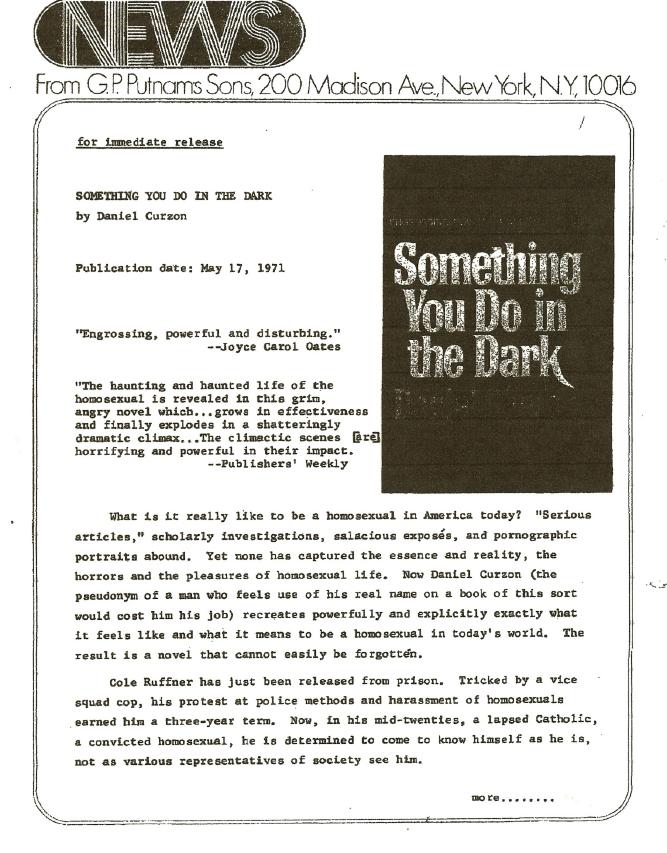
SOMETHING YOU DO IN THE DARK
SOMETHING YOU DO IN THE DARK Putnam 1971 by DANIEL CURZON:
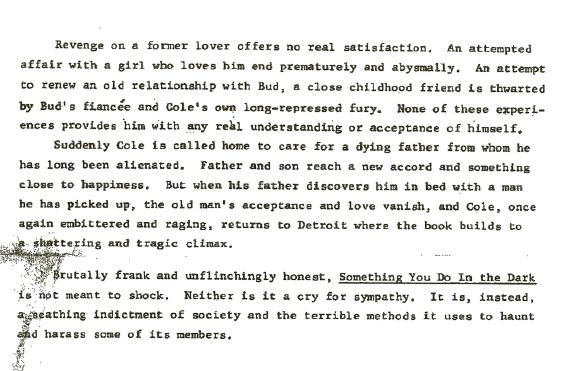
The first gay protest novel is story of a gay man's attempt to avenge his entrapment by a Detroit vice squad police officer by murdering him
Reviews: . . . This is an important novel especially for the younger gay generation so they can know that the rights that we have today were brought about at the pains of another generation. It is a political statement against the powers that were and we see just how vulnerable we were. The same kind of vice squad action is still here and it seems that it will always will be. Everything about his book is still relevant today but not as overt as it was the 1970’s. . . . Curzon uses his novel to show us how the gay population was once treated and we owe him a great deal for that. He has given us unforgettable characters who lived at a time when it was not wise for someone to proclaim his sexuality. Everyone should read this and then use what was read to help create a better and more accepting world. – Amos Lassen, Blog at Wordpress, Reviews by Amos Lassen
“Engrossing, powerful, and disturbing.” – Joyce Carol Oates (front cover blurb, 1971 Putnam edition)
“Something You Do in the Dark . . . is a real novel, not a political tract. It deals convincingly and powerfully with the persecution of a minority, but it tells the story of an individual, not a representative martyr. Its hero is torn between rebellion and cowardice, love and rage; he is never too good to be true. I greatly admire Daniel Curzon for writing this book.” – Christopher Isherwood, 1974
“Powerful and engrossing!” – Walter Allen, author of The English Novel
“I think Dark is truly ‘powerful and engrossing.’” – Michael Sarotte, author of Like a Lover, Like a Brother
“I read the book when I was young. It was a gift to all of us.” – David Mixner, Author/Activist
“Brutally frank and unflinchingly honest, Something You Do in the Dark is not meant to shock. Neither is a cry for sympathy. It is, instead, a scathing indictment of society and the terrible methods it uses to haunt and harass some of its members.” – from original press release from G. P. Putnam, 1971 hard back edition.
“At last, a true-to-life portrait of a gutsy gay male: fast-moving, up-to-date, healthy and courageous. We rooted for him from cover to cover, and we’ll remember him for a long time.” – Lige & Jack, Editors, Gay (newspaper), 1971 (back cover of original Putnam edition)
“. . . Curzon’s novel surpasses its predecessors in harsh, beautiful honesty, in liberated grasp of the subtle varieties of homosexual character, in anguished, unsentimental protest and it its spirit of nowness.” – Jim Kepner, The Advocate, 1971 (back cover blurb for original Putnam edition)
“Almost three decades after I first read it, Something You Do in the Dark is still a powerful and provocative reading experience.” – Jesse Monteagudo, The Lost Library: Gay Fiction Rediscovered, 2010
“SOMETHING YOU DO IN THE DARK certainly deserves a wide readership and should be on every list of classic novels with gay characters-- whatever that means-- and should be considered with CITY OF NIGHT, GIOVANNI'S ROOM and THE CITY AND THE PILLAR.” – H.F. Corbin (Amazon Top 500 Reviewer), 2010 | ||
| | |
 | ||
| | |
 | ||
| | |
"The Gay Ones " An uncommon, primary and early gay male "pulp" referenced in Ian Young's magnificent and comprehensive "The Male Homosexual in Literature: A Bibliography."
"The Gay Ones" (1958) written by Eve Linkletter (whose photograph appears on the rear page; my notes indicate that there is some belief that the writer was not Eve Linkletter but rather a male) published by Fabian Books out of Fresno, California. Issued as a pocketbook "pulp" only and containing 128 internal pages.
From the front cover: "Were they pranks of nature? Or were they the third sex - the gay ones?"
The first inside page introduces the novel:
"Jerry lay back on the grass as Ted started to rub his cramped leg vigorously. Jerry could feel the circulation returning, and the cramped feeling was leaving. Ted looked admiringly at Jerry's naked body, and Jerry noticed a strange glint in his eyes.
"'Is something wrong, Ted?'
"Ted's voice filled with emotion. 'Don't you know that we're different than the other guys? You don't go for girls any more than I do.'
"'What do you mean different - in what way?'
"'We don't go for girls, we go for boys.'
"'Maybe you do, but I don't,' Jerry said in defense as he got up and began to dress. Ted got his clothes and started to dress also.
"'You just don't know it yet, but I've watched your actions, and I know another one of my kind when I meet him. You even act like a girl about undressing.'
"'I'm just modest, that's all.'
"'Don't let it bother you, but if you do admit it some day, let me know, as I've always gone for you. Don't condemn me for what I am, Jerry; there are three sexes, even Kinsey admitted that, and well - I guess I just happen to be in the third category.'"
Several pages to the rear are devoted to descriptions of other Fabian titles for sale, and periodic commentary, including the one-page "GOVERNMENT ATTACKS FABIAN BOOKS."
===============
"Modern Times: Observing the Developing Gay Future" (1979) - "Volume: High, Tone: Intense." Published by the March on Washington D.C. Committee, San Francisco, then located on Castro Street, a large newspaper containing four pages including front and rear covers.
Contents include:
-cover article on the upcoming "March on Washington: October 14, 1979" (with photograph of delegates voting on the Washington, D.C. March date at the now-famous Philadelphia Conference);
-article "Third World Gay Conference";
-article "Be A Flag" (urging gays and lesbians to purchase and carry a flag at the march: "blue for Lesbians, red for Gay Males, white for Parents of gays, and green for Straight friends");
-article "Why The March?";
-half-page advertisement from Pegasus Travel ("Ride The Gay Freedom Train To The March On Washington!");
-list of endorsements for the March on Washington (including Harry Britt, Jane Fonda, William Kunstler, ACLU San Francisco Gay Rights Chapter, Alice B. Toklas Democratic Club, Cleve Jones, Jack Campbell, Leonard Matlovitch, Dade County Coalition, Harvey Milk Gay Democratic Club, many others).
Double Switch 1964 Transvestite Novel
"The Turn-About Party" (1972), a transvestite novel by an anonymous author (possibly by Virginia Prince, who sometimes wrote anonymously) and published by Virginia Prince and Chevalier Publications out of Los Angeles, California. Issued as a stapled softcover only, measuring 5-3/8" by 8-1/4" and containing 48 interior pages.
Containing four full-page illustrations, the novel is a delightful account of male transvestites and their understanding wives. A few brief excerpts from the beginning of the novel:
"It all started on a Wednesday morning early in the fall as I was working at my desk at the bank. Ruth, my wife, called me and asked me to withdraw $50.00 from our savings account before I came home. She would not tell me what it was for, but said she would later. Of course, that put me on edge for the rest of the day. I did take the money out of the account as directed but wondered what kind of trouble she had gotten into now...
"...'I'll tell you after supper,' was all she would say. 'It must be real bad if you want me to get supper down first,' I retorted. The meal was a flop as far as I was concerned, I don't know what I ate. I was really getting worried. After the dishes were washed and put away, we went to the living room where we could be more comfortable to talk things over.
"'This morning I received a telephone call from Barbara Johnson, and she invited us to a party at their home two weeks from Saturday night.' 'So let's go,' I answered abruptly.
"'Okay, but wait til you've heard more about it,' she said impatiently. 'It will be a turnabout party with the fellows dressed as girls and the girls as boys. Barbara also said that there would be expensive prizes for the best and most convincing couple, and you know what their prizes are like'...
"We had been to the Johnson's parties before, and as Ruth said, the prizes were wonderful. Ed Johnson owned an electrical appliance store and they donated the prizes.
"'Oh, yes, Barbara also said that we should start in right away getting our costumes together and for you to get high heels and learn to walk in them, as the other six couples had been notified last Sunday. Well, what do you think? Do you want to go?'
"'Well, that is a surprise all right and quite a relief,' I sighed. 'I thought you had gotten into something. Of course I'd like to go, but don't forget what I told you before we were married. I have dressed like a girl before and I did enjoy it, and I promised not to do it again, but lately I have really had the urge again. Maybe this will dispel the urge, or maybe it will make me want to dress more often. I think the decision should be up to you.' I warned her..."
"From Martin to Marion: A Transvestite Story in Three Parts" (1970) written anonymously (possibly written by Virginia Prince, who sometimes wrote anonymously) and published by Virginia Prince and Chevalier Publications out of Los Angeles, California.
Volume One measures 5-3/8" by 8-1/4" and contains 64 internal pages; Volume Two measures 5-3/8" by 8-1/2" and contains 72 internal pages; and Volume Three measures 5-3/8" by 8-3/8" and contains 52 internal pages.
The subheading for each volume is as follows:
Part I (Volume One): "Martin Discovers Marion"
Part II (Volume Two): "Marion Goes to New York"
Part III (Volume Three): "Martin Becomes Marion"
Transvestite novel "The Birth of Barbara" (1973) written anonymously (possibly by Virginia Prince, who sometimes wrote anonymously) and published by Virginia Prince and Chevalier Publications out of Los Angeles, California. A stapled softcover measuring 5-3/8" by 8-3/8" and containing 104 pages including front and rear covers.
Containing full-page illustrations throughout, the novel tells the story of married couple Paul and Amy, who are experiencing marital frustration ("What's for dinner?" Paul asked upon returning home from work. "Hamburgers" replied Amy. "You're kidding. We've had hamburgers twice this week already" Paul complains), Amy's desire to return to her modeling job which requires a domestic role reversal in their marriage ("I doubt if I'll ever be the housewife type" Paul states), Paul's enjoyment of being the "wife," his awakening interest in wearing women's clothes, and Amy's ultimate acceptance of her husband's second mirror personality, that of Barbara.
AFTER DARK
"After Dark" Magazine Inc. The Magazines ran monthly from May of 1968 until December 1981. Then in 1982, the Magazine was only published in these months of January, March, April, September and a combined October/November Issue. 1983, January being the last issue ever printed. There is a total group of Magazines issued by this Company of 170. Also included in the 1968 Series are three seperate issues of three "spin off" Magazine Issues produced by After Dark Inc. They are September 1967-"Dance Magazine", April 1968-"Ballroom Dance Magazine" and August 1968-"Dancing Times Magazine". AFTER DARK was one of the pre-eminent gay magazines from the 70s, and "the national magazine of entertainment." AFTER DARK was an amazing magazine of style, arts and very often homoerotic photography that defined the look of 70s gay chic. It was the home of such legendary photographers as Kenn Duncan, Roy Blakey and Jack Mitchell, along with new and upcoming masters, like Bruce Weber. It featured writers like Bill Como and Norma McLain Stoop, who knew how to spin a good yarn out of the barest essentials. Each issue was packed with sexy photo spreads, kinky fashions and intriguing interviews, and often featured artistic nude photography. Technically, AFTER DARK was in the closet since it preferred to play tongue-in-cheek with the gay content of its pages. But in retrospect it is a microcosm and a time capsule of the burgeoning gay liberation lifestyle and the rock and disco eras.
About this site: Ebay is an amazing place and reasource. There I found these wonderful detailed and annotated descriptions of various important and early gay publications. I felt compelled to save and share them. They are published here with the author Brad Confer's consent. They were written for the sole purpose of selling the material on Ebay and not with scholarly intent, but they are such a rich resource as is, that I present them here. It has taken me almost as much work as Brad to collect, reformat, organize and publish this information. Please write me if this site is helpful to you. If you want to contact Brad, his business is Bloomsbury Books and you can email him at bloomsbury@earthlink.net Most of these issues can be found at the New York Public Library, McCormick Library of Special Collections and the Canadian Lesbian and Gay Archive among other places. | ||
| | |
| ||
| | |