![]() | ||||
![]() | ||||
Introduction
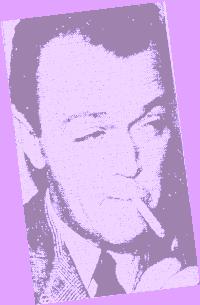
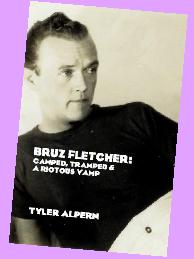
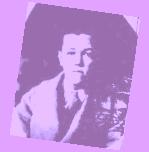
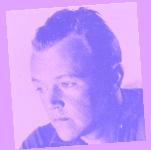
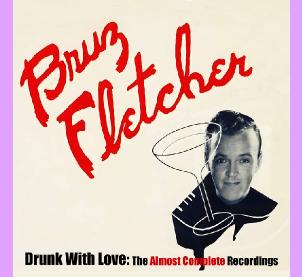
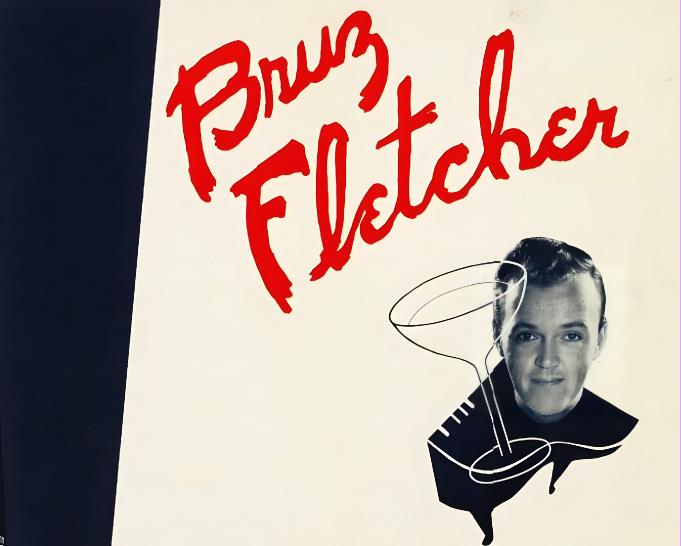
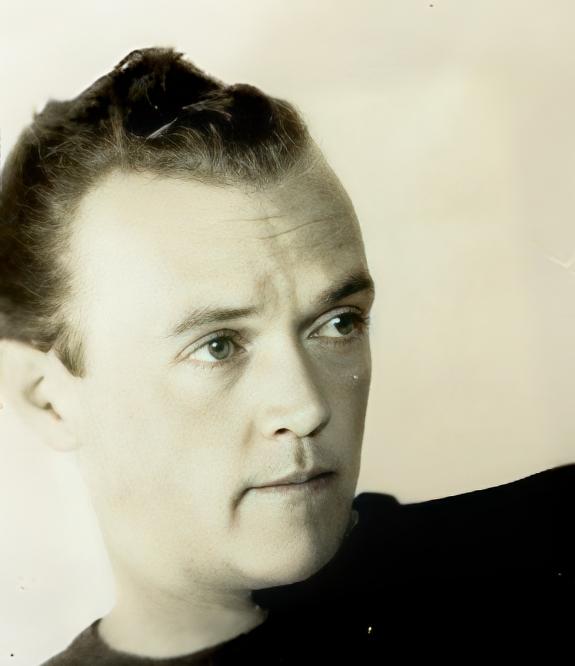
He had “a level of genius equaled by very, very few,” recalled one of his fans. He became a master of gay code and double speak in order to survive and flourish in a very homophobic era. A singer, composer, novelist, playwright, the darling of sophisticated night spots in the 1930s, gay performer Bruz Fletcher remains as mysterious today as seventy years ago. Though he killed himself at age 34 in 1941, he left behind 3 albums of wonderful songs and 2 novels. His drama filled life was a riches to rags saga, a wild and sad story of extremes and incredible plot twists. No other significant article or source on Bruz’s life or career seems to exist, except David Diehl’s Discography. This website is a designed to be a forum to collect and share data about Bruz. Please feel free to contribute any knowledge you might have!
Research has revealed tantalizing clues and yet little about this amazing performer and the goal of this website is to rescue Bruz Fletcher and his music from obscurity. Georgia Cravey was also gathering and shared data. Georgia continues to contribute often and our work complements each other's perfectly. Stuart Timmons and others have since gotten involved.
I discovered Bruz Fletcher through my intense research into singer Frances Faye. I created a similar website to document her career, contributions and music because so little had been published. It has since grown into a massive collection and resource of previous unpublished media. It is my hope that through this forum more can be learned and documented about Bruz Fletcher.
When I was in third grade, I was assigned to write a report on a famous person from Indiana. The subject of my assignment was my father. Although well known in his field, he was not the kind of celebrity my teacher had in mind. (Plus, he was born in Pittsburgh!) After all these years, perhaps now with this project I can make that teacher happy.
Please e-mail Tyler Alpern at Tyler_alpern@yahoo.com to contribute. No detail too small or insignificant. Each bit of trivia and source helps to build the story.
I would be willing to buy or trade for Bruz related materials. I have a large collection of rarities I am willing to trade. Images would be most welcome!
LOTS OF EXCITING NEW RESEARCH COMING TOGETHER SO CHECK BACK SOON.
Last Updates: 2/13/08: Joyce Bryant 7/27/07: New paintings on this page and page 4. Lots of new info added and coming soon. Wilbur Stump. 11/19/06 New Alex Gildzen poem about Bruz at bottom of the page. Check it out. Broughton poem on Bruz. 10/22 Site restored after biographical info was temporarily removed to protect research. Stuart Timmons' article in the Gay & Lesbian Review about Bruz and this site published in Nov/Dec Issue. 09/09 More Casey Roberts on Page 2. Mark Miller comments below. New images. BRUZ'S 100th Birthday was in March! A special new page with new photos and info was launched on the day 2 new photos of Bruz were previewed. In its place is the new Casey Roberts page. 02/06 Thomas Gladysz of the Louise Brooks Society is helping with research and leads. He placed Bruz and Casey in Newport in 1932 and will feature him on Radiolulu. .Bruz runs away, 1929 bungalow. Bali details on Career Page. More Louisa and Casey. Pearl Bailey. 06/05 (new images, more family interview, Julia Ballard removed, 1st gig, liner notes) 05/05 (Stuart's additions to Comments, Pansy Craze & Glossary; edits and rewrites; more Greer letters, family interview & Photos Page) 2/05/05 (Bathurst Scandal, More Parties, Press & Acts) 01/09/05 (Series of 1938 tragedies below, Father's financial details on Family Page) 12/24 (Many details inserted all over the pages) 12/15 (Casey Roberts, Julia Ballard, Louisa below & on Family Page) 12/10 (Esther Ralston - Career Page, more Jack Sowden) 11/1 (new lyrics, glossary, Orpheum, Bali/LAPD) 10/23 (details in comments section about Only the Rich, Lily Laws, family) 10/20 (new lyrics, new club dates) 10/15/04 (new Bruz story, closing of Bali, new sources, engagements) August 2004: Site launched.
Pansy Craze and Anti-Gay Laws
In the early 30's when Bruz Fletcher’s short career began, gay clubs and performers were an underground rage. It was called the ‘Pansy Craze’ and performers were known as ‘pansy performers.’ Ray Bourbon (later known as “Rae”) is the best remembered of these artists. Jean Malin and Karyl Norman were perhaps the most famous at the time. Unlike Bourbon and Norman, Fletcher was not a drag performer but composed and sang clever, slightly risqué songs akin to rhyming style of Cole Porter and Noel Coward. In a similar vein, Dwight Fiske also emerged at this time. And later the infamous Spivy.
Prohibition, which ended in 1933, had created a network of exclusive clubs with an “anything goes” culture where gay entertainers flourished. The owners of these clubs grew used to paying off police from raiding and closing the clubs. After Prohibition the atmosphere changed. New York (and many other states) enforced laws that prohibited homosexuals or ‘known perverts’ from congregating in licensed public establishments or from even being served alcohol thus the gay clubs these artists performed in remained illegal. By the mid 1930’s any homosexual theatrical content was banned by law in most jurisdictions. Gay sex was still illegal and California Penal Code Section 647.5 allowed for the arrest of “idle, lewd or dissolute persons or associates of of known thieves.” The Los Angeles Vice Squad used this vague law as their primary charge to arrest gay men for offenses such as dancing together even at a private party in a private home, or for being too flamboyant in a bar. The “lily law” or “Alice Blue Gowns” would stake out homes of homosexuals and if they found a simple party in progress, they would burst in and arrest everyone in attendance on a “morals charge” and haul them down to the "fruit tank." Twenty people at a time could be arrested. In many places these laws were in effect and enforced until the 1970s. (Remember the Stonewall rebellion did not begin to trigger substantial social and legal reform until 1969.) Even after Prohibition ended, until 1967 it remained illegal in New York City to sell or serve alcohol to a gay or lesbian person thus making gay clubs underground, hazardous places. The New York Times regularly used the term ‘pervert’ to mean homosexual. In 1951, California Supreme Court finally declared it was illegal to deny a bar its liquor license just because its patrons were gay, so four years later the state passed allow preventing gays from congregating in public places thus denying licenses to bars that were "resort for sexual perverts." Into the new millennium there were still laws on the books banning gay sex in some states and gay marriage!
Back in the late 30’s, clubs were constantly raided because laws on both coasts prohibited drag (even for performers), any “nance” theatrical content or lewd behavior from patrons including any touching, dancing or being overly flamboyant. Simply asking an undercover cop in a bar or party in Los Angeles to “go home to my place,” or putting a hand on someone's leg was cause for arrest. Any sympathetic portrayal of gay characters termed ‘sexual perverts’ was prohibited by the motion picture production code from being included in Hollywood films. Performer Ray Bourbon was arrested in Los Angeles innumerable times for an act that is tame by today’s standards and completely free of four letter words. In 1940, laws were so strict that Julian Eltinge (who for thirty years had been a huge national star of legitimate stage and screen as a female impersonator with wide mainstream acceptance and success) could not get a waiver from the LA police to perform in drag. For his act he was forced to wear a tux and perform while only pointing to his famous gowns hanging on racks behind him. It became very difficult for gay performers to find work. This was the era and these the conditions in which Bruz Fletcher forged his short career. Stuart adds: Bruz Fletcher's songs make a fascinating study as well as still-heady entertainment. His lyric gender-play reveals the necessity for gay men of his generation to speak out of three sides of their mouths. While he salts his songs with gay code, he also speaks to the general public -- or at least the sophisticated public. Sexually aware straight men and women formed the financial base of audiences that gave him his own nightclub for the better part of a decade.
The fluid consciousness of 1930s queerness is long-gone, along with the "scientific" ideas about homosexuality, like being trapped in the body of the opposite gender, but some of that glimmers through here. Some of Fletcher's songs sound tailored to carry one set of meanings to heterosexuals and another to gay men, much like Cole Porter's. The fact that Fletcher employed a speedy and sometimes blunt wit strikingly similar to that of Rae Bourbon is telling. Noel and Cole, for all their outrageousness, were careful not to cross certain lines or close certain doors. Bruz Fletcher was clearly more daring -- more confident, more careless, or a volatile mix of both.
The website's content is copyrighted and registered. No material from the site may be republished, copied, posted, rewritten, printed, photocopied, broadcast, publicly displayed, or distributed in any way without prior written permission except that you may view many of the site's pages with a web browser and you may print a single copy of those pages for your personal, noncommercial, home use. Copyright Tyler Alpern 2004 -2007. Paintings by Tyler Alpern | ||
![]() | ||||
Bruz Fletcher Biography: Short Version | ||||
Bruz’s given name was Stoughton J. Fletcher IV. His family can be traced back to Robert Fletcher, who emigrated to America and settled at Concord, Massachusetts, in 1630. The family then moved to Vermont and finally settled in Indiana in the early 1800’s and entered the banking business. Fletcher banks dominated the Indiana financial market and the huge family had great influence over the state. The Vermont branch of the family boasts a Governor and donated several public buildings.
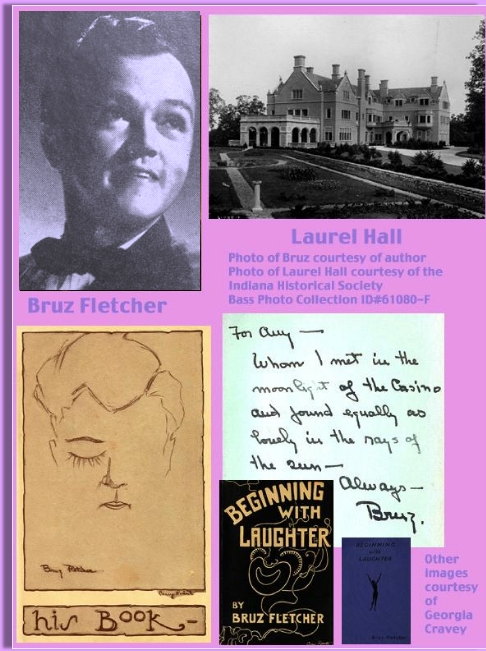
Bruz was born in 1906, in Indianapolis the son of an affluent banker and businessman. His father Stoughton A. Fletcher III also owned the large estate and farm Laurel Hall that bred famous racehorses including Peter the Great and The Senator. He bought the pioneering automobile engine part manufacturer Remy Electric Company for a million dollars and invested in oil fields. The family traveled the world on their own private yacht. The fifty -room blond brick mansion at Laurel Hall took 2 years and 2 million dollars to build. The 30,000 square foot manor built from the profits of the Delco-Remy deal was staffed with cooks, maids, a butler and horsemen; it was the “scene of the many of the most brilliant social events of the last few seasons,” according to the Indianapolis paper, “Mrs. Fletcher was of an artistic temperament, and much of the beauty of the home is due to her originality and artistic taste. For all its grandeur, it possesses a homelike atmosphere.” The party celebrating the opening of the estate was so large that cocktails were said to have been mixed in washing machines. "No one lived as lavishly, with as many parties and as long guest lists as the Stoughton A. Fletcher III family," reminisced society writer Margaret Wildhack.
Bruz’s aunt, the poet (Laurel) Louisa Fletcher, married famed playwright Booth Tarkington. His heavy alcoholism was the cause of their divorce in 1911. Their only child, Laurel was born a month before Bruz and the two were very close. She also grew up in Indianapolis and attended posh boarding schools. When they were both age 9, an imaginative Bruz and his cousin Laurel wandered all the way to Acton, Indiana, where they apprehended by authorities. They assumed the names Lark and Lester Coburn and claimed that they lived at 105th Street in New York City and had spent four days walking to Indiana. They stuck to their story until they were retrieved by "a servant" in a touring car. Then they admitted that they "just wanted to have an adventure." Laurel later developed schizophrenia and died at age 16 of pneumonia. It was one of the many tragedies that mark Bruz’s young life and color his work.
Bruz was educated at the Brooks School for Boys in Indianapolis where he worked on the school paper. In 1917, he and an Indianapolis friend Cortland Van Cleve attended the same prestigious boarding school but in January 1919 the twelve year old Bruz shot himself and as a result of that incident was transferred to Lake Placid School at Coconut Grove in Dade Co. Florida. His headmaster at the school wrote to his father: “It seems first that Stoughton’s position at the School would be somewhat equivocal one because of the rather mysterious circumstance in which he shot himself ... I am relatively certain that Stoughton’s qualities of leadership are such as would enable him to persuade most of his companions that the act had been done with suicidal intent and that he was misunderstood by the authorities who feel his action was not serious.”
A 1934 letter to an older cousin confessed that when the two were in school, Bruz told Cortland he had never kissed a girl. He hoped the discussion would lead to an admission that Cortland too had never kissed a girl, because he wasn't interested. Cortland seemingly innocently offered to teach Bruz the fine art of kissing. The two boys often practiced on each other when no one was looking. Bruz was dizzy with excitement as Cort's lips brushed his. Bruz hated boarding school and wrote that Cort was the only reason he could can bear to be there. During one of these kissing sessions, the boys were interupted by Cortland’s roommate and some other boys and almost seen in the act. Cortland covered up by punching Bruz and telling the other boys that Bruz was a sissy and tried to kiss him. Broken hearted and humiliated Bruz shot himself. Bruz was dismissed from school and eventually dispatched to a military academy where he was joined the drama club. However, back in Indiana and as they matured Cortland and Bruz's affair continued and buit in intensity . On school holidays, they would reunite late at night after escorting their females dates for the evening home. Cortland had a disdain for underwear. He told Bruz the French never wore underwear and it was very continental to go without. He was proud of his manly silhouette and the bulge the lack of underwear created. On the back of a photo that Bruz always kept of Cortland was written, "Cort. A woman's eyes. A soft voice. A horse’s prong."
In 1920, Bruz's sister was expelled from a second school for smoking, drinking and gambling at parties with her teachers and engaging in "other Bohemian activities." She was sent to the summer home with a governess from whose guard she escaped, then she chopped off her own hair, stole a boat and disguised as man using the alias Willie Sullivan, got a job as a farmhand but was soon apprehended. | ||
![]() | |||||||
Bruz's sister cuts her hair, disguises herself as a man and runs away. | |||||||
Bruz's aunt Louisa Fletcher Tarkington | |||||||
Adding to his own troubles, in 1921, while Bruz was home for spring break from Howe Military Academy and his father was in Chicago on business, his mother May killed herself by drinking poison during an illness inspired depression. Bruz’s grandmother Eva Henley died suddenly just an hour after finding her daughter’s lifeless body. When the butler stepped away from the scene to call a physician and fetch some whiskey, Mrs. Henley took a sip from the glass of poison to find out what it was and accidentally killed herself. Bruz’s unconventional older sister Louisa soon ran off again and joined a musical revue. Back home things grew worse, Stoughton Sr.'s business deals started to sour. Then, early in morning of New Years Day 1923, Bruz's 19 year old boyhood friend Cortland Van Cleve III, on the way to visit Bruz after a late party, crashed his car and died only an eighth of a mile from Laurel Hall. Bruz was a pall bearer at his funeral. Later that year, Stoughton III retired from heading the family bank and in 1924 he declared bankruptcy, claiming $1,763,602.54 in debts and $481.39 in assets. Ironically, Laurel Hall, named after generations of Fletcher women, was repossessed by the Fletcher American National Bank and was converted into Sisters of Ladywood, a Catholic school for girls. Possessions were auctioned off. Racing cars lavished on Bruz by his father went to creditors. At age eighteen, Bruz published his first song.
The family left Indiana and moved first to Florida and then soon after to California where a ridiculous drama eventually took place that actually gives credibility to the silly high society escapades and plot twists Bruz would later write. First, Louisa traveled to Europe where she had a very public engagement with a German Count. It was nationas news. But the nuptials were abruptly cancelled on the eve of their wedding. Later, while out on parole in early 1927, Louisa and her “companion” Ruth beat up Lady Diana Bathurst. Lady Diana was a fraud, had several names, and claimed to be Viola Hurst. Louisa pled guilty to a charge of assault and battery of now Virginia Hurst and was fined $50 and received a suspended sentence. A week later the court dropped the charges against Bruz. Months later in 1927, after suffering a lingering illness, Louisa died of meningitis at age 24 “under tragic circumstances”. It was Bruz's unhappy duty to accompany the body home to Indiana. By the market crash of 1929 the family had lost all its assets.
In 1926, the “penniless” Bruz moved to Hollywood and “eked out” a living writing music for motion pictures and was the composer of the songs “Dream Girl” and "Cocaine." By 1929, he and his partner, a gifted and multi-talented artist named Casey Roberts, had taken a bungalow in the Hollywood Hills. Their home had become a cozy, well-known salon for Hollywood's most talented artists, performers and behind the screen talents.
Bruz created a unique niche for himself by writing specialty songs and acts for many of the era’s popular but now forgotten stars, most of whom were former silent film actresses who tried performing in live venues and vaudeville after the advent of talking pictures. Halloween of 1929 found Bruz on the Vaudeville stage of the Los Angeles Orpheum accompanying silent screen star Esther Ralston in an act he wrote for her. In the early 1930’s Bruz was in New York and was said to have performed at the gangster owned Club Argonaut along with Frances Maddux. He wrote songs for a Peggy Fears revue that included bright Broadway star Queenie Smith and Milton Berle.
By 1932 Bruz and Casey were living in Newport, Rhode Island's artists' colony on Washington Street. That year Bruz published both his novels. The New York Times Book Review summarized the first as: “...the glorification of New York’s Nightlife - its supper clubs, its song writers and gigolos, its dancers and bootleggers. About the slender romance of Judith Arden, who stepped out of the social register to capitalize her beauty and position as hostess in a night club, and Peter Martin, a handsome young man who wrote songs that no one appeared willing to buy.” The parallels to his life and the fiction he created were numerous and obvious. Within the first three paragraphs of his first novel, the heroine’s father declares bankruptcy and everything is sold but not before her mother takes to bed and kills herself. Peter Martin eventually reveals many clues about Bruz’s own psyche and experience. Bruz himself seems to be a perfect mix of both Judy and Peter, almost as if he split himself in two in order to create the fiction. The novel included a plate of Casey Roberts’ portrait of Bruz. The second book is again a high society affair, the most memorable character a saucy dowager of the type he would later cast in a few of his best songs. Just as the first book seems to parallel his own life, the second loosely retells many of the public turmoils of Bruz's older sister : how she ran away to make a life for herself, took an alias, a failed society wedding to a foreign count. Surprisingly, the writing does not feature the cleverness, humor or complex characterizations that his short narrative songs do. His novels are much more similar in style the popular plays and musicals of the thirties whose complicated plots and shallow characters do not hold up to the test of time. But his bright songs have a strong sense of humor and humanity that has kept them fresh and relevant after 70 years.
Not much is known about Bruz's work as a playwright. During the 1930s, he did write at least 6 plays produced primarily for summer stock. AGGIE'S AFFAIRS, a comedy, premiered in Connecticut in the summer of 1932 and was written as a vehicle for its female star. Bruz co-wrote NOT A SAINT based on the short life of actress Jeanne Eagels who committed suicide. It was produced in Boston in June of 1933 and starred Queenie Smith who would become a good friend. In 1936, another comedy COMMUTING DISTANCE opened on the New York area summer circuit. Then in 1940, plans to produce a comedy about another actress AH, LOVELY DAY were announced in New York. Clues to its plot might be found in his 1940 song about an actress, "Miss Day."
1934 was a banner year for Bruz. He was the star of the Casino Town Club on New York’s famous 52nd Street from February thru October. In March, he had briefly shared the bill there with Nan Blakstone and that spring he recorded his first records. In April, he entertained along with Blakstone and Queenie Smith at a celebrity and society gala to benefit orphans.
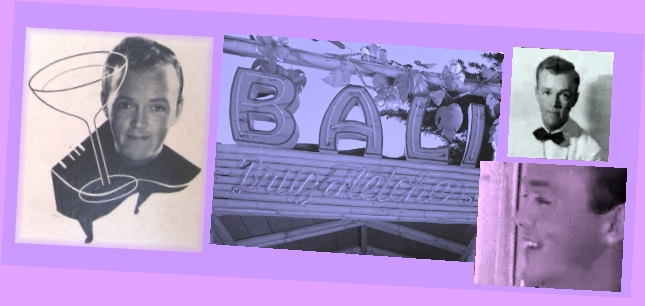
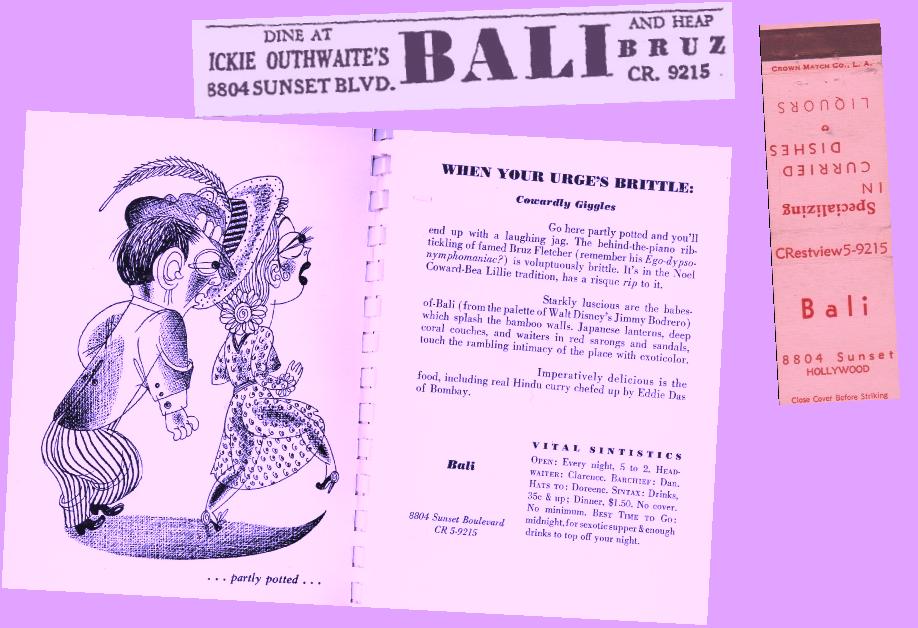
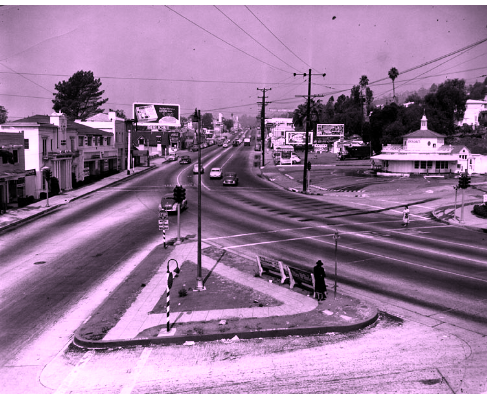
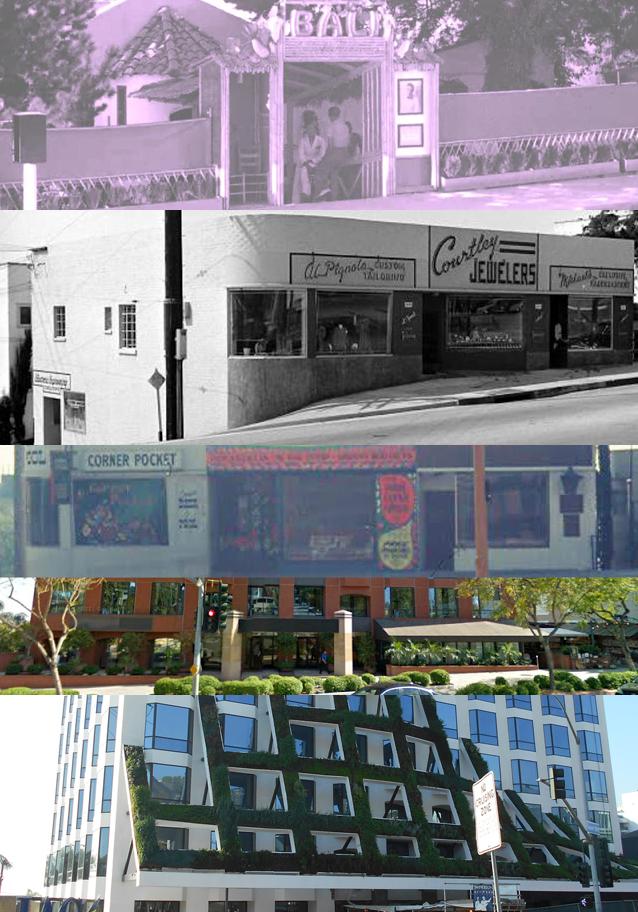
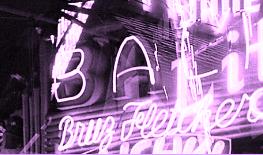
Back again in California and billed as “the Satirist” Bruz performed at the famous Cafe LaMaze in the fall of 1935. But more significant, earlier that year in July, he had opened the new Club Bali in Los Angeles. Originally booked for two weeks, it became an engagement that lasted several years. Owned by investors and managed by legendary party giver and Jeanne Eagels' former finace Gilbert “Icky” Outhwaite, Club Bali was often referred to as “Bruz Fletcher’s” and was one of the first gay bars on the Sunset Strip. Unlike other gay venues, this club managed to survive because it was placed at 8804 Sunset Blvd. on a small section of road just outside of the jurisdiction of the LAPD and attracted a mixed crowd. It called itself “The ‘Gayway’ of the Strip.” It featured Balinese cuisine, coral red couches and waiters clad in red sarongs. The pioneering Hollywood costume designer and flamboyantly gay Howard Greer wrote about many of his excursions to the Bali. One of his letters reads:
"...afterwards I went a-dining with Travis Banton and his husband (the three of us filled to the rims with rum punch) and after dinner we did the nightclubs. If memory serves (and how seldom it does!) we ended up at the Bali where, at the next table, sat a blond marcelled young man who turned out to be Ted Peckham, the lad who runs the escort agencies. We asked him to our table and, my pet, before the dawn came we hadn't left him a French heel to stand upon. Shreds we tore him into!! And when he naively and oh so earnestly said to us that he wanted to become known as "the glamour boy of Hollywood!" we had a collective stroke."
Bruz performed at the Bali 50 weeks a year for four and a half years, then for just a few months in 1940. In 1938, columnist Hedda Hopper wrote that Bruz had the longest local run in nightclubs of anyone she could remember. The press reported on celebrities who frequented the Hollywood nightspot. Read Kendall's gossip columns for the Los Angeles Times regularly mentioned who went to and was seen at Bruz Fletcher's Club Bali. For instance: Kendall records fading star Louise Brooks attending performances of Bruz Fletcher at his Club Bali 5 different times in 1937 and 1938. Gay costume designer Travis Banton was her companion on two of those reported outings. Bogart, David Niven, King Vidor, Howard Shoup, Monty Woolley, Beatrice Lillie, Laura Hope Crews, Norma Talmadge, Ronald Reagan, Howard Hughes, stripper Gypsy Rose Lee, dresser Adrian, wicked witch Margaret Hamilton, tin man Jack Haley and wizard Frank Morgan all went to the club. Bruz’s name and the Bali appeared in the LA Times about two hundred times. William Mann in his book quotes articles in the Hollywood Reporter and Variety mentioning Joan Crawford, Cary Grant, Tallulah Bankhead, Ethel Barrymore, Howard Hughes and others visiting “queer clubs” and "panze joints." An album of Bruz Fletcher’s records is still to be found in Ernest Hemingway’s collection at his residence museum in Cuba.
Papers reported Bruz and Casey both among the guests to many glamorous parties. For the occasion of Casey’s birthday and that of a few other mutual friends Bruz announced that he would give a ‘high’ time party at ‘high’ tea. Patsy Kelly, Alice Faye, Esther Ralston, Howard Greer were among the many guests the newspaper listed. A letter written to James Broughton from Howard Greer in 1937 describes that party:
The only other spot of news I have to offer is that last week Bruz Fletcher gave a “High” party. Everyone was expected to come dressed up as- or suggesting- anything “high”... like high blood-pressure or high finance or high-tide or high-enema (there were three!) or high-gas or high-fallutin’ or Hi’ Toots or Hypocondriac (I’m afraid I left an “h” out of that word!) or high-seas...well, it goes on forever...I was High Tension. Gypsy Rose Lee came as High Handed, bearing two stuffed gloves on the end of a cane. The only reason on earth for my bringing all this up is that I had to tell you what a phoney Miss Lee is. Honestly, when a strip-tease girl does “lady” on you, it’s the end! She’s duller than dishwasher and not attractive and when she opens her mouth pearls of great luster do NOT come tumbling out.
This type of bitchy society gossip provided the inspiration and subject for so many of Bruz’s songs: She’s My Most Intimate Friend, Miss Day, The Hellish Mrs. Haskell (Society Lady), Hello Darling, and Mrs. Lichtenfall. His highly narrative songs mostly reflect the wealthy lifestyle he was born into and the cafe society he became a glittering part of. Although they are amusing fictional tales, they are autobiographical windows into his world. One can't help but speculate if there is not some autobiographical truth in the song "Peter Lillie Daisy." It is the story of a demanding father and oddly gendered child who eventually finds success, happiness and acceptance in Hollywood and writes his father off. His songs are a showcase of his quick comic wit, but include a heavy mix of tragedy. His protagonists often have terrible ends in spite of the light, happy nature of the songs. The “gorgeous” gay butler in “Mrs. Lichtenfall” is shot dead, the madcap society girl turned movie star Miss Day dies young, the Adonis-like traveling salesman Hilly Brown is castrated, and perhaps drawing a bit from his own life: a mother is poisoned. Fletcher’s two love ballads “Reminiscent of You” and “Drunk with Love” leave the singer/composer ultimately alone. “Oh, For a Week in the Country,” "The Prairie" and “The Simple Things of Life” are not at all what their titles suggest but are in fact genuine love songs to the modern urban life of the well to do. A definite homoeroticism flavors his entire songbook. “Oh, For a Week in the Country” and "The Prairie" are rich with gay code and double meanings but "My Doctor" is a transparent and unashamed gay love song. There is an occasional sense of elitism in his lyrics and writing that clearly reflect his privileged upbringing and a definite distrust and indifference to “servants.”
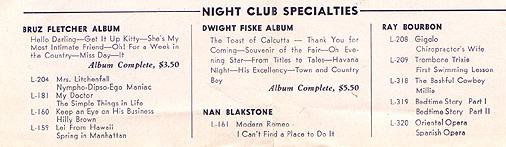
Bruz recorded for the small independent label Liberty Music Shop that specialized in novelty songs and stage personalities Due to the bawdy nature of the material on those and other labels, the popular risqué party records had to be sold "under the counter." His songs have a only a few direct uncoded homosexual references but can be described as sophisticated, energetic, witty, gossipy, campy, bitchy, cosmopolitan, bawdy; in a single word gay. They are full of rhymes, innuendo and amusing puns much in the manner of fellow Hoosier Cole Porter or Noel Coward. The double entendres in "Lei from Hawaii" and "Keep an Eye on His Business" are cheeky and irreverent. Bruz wrote and performed in an era when homosexuality was considered a perversion by the medical community and a sickness to be cured. He spoke out against that mentality in the only way he could, guised in metaphor and comedy. In the lyrics to "Hello Darling," he substituted his own love of his pet monkeys with his own sexual orientation in order to mock modern psychiatry's primitive understanding of sexuality. His phrasing and delivery were quick and clipped, often more spoken than sung in his melodious high voice. He had that rarely heard today flat upper-class Midwestern accent that Ruth Draper so brilliantly imitated. He did not lisp but did have a speech pattern called assibilation that to this day sends most gaydars pinging. To clarify, “some North American gay males do pronounce sibilants (s, z, sh, and the like) in a distinctive way - by adding more sibilation, hissing, or stridency, a phenomenon phonologists call assibilation.”
Researcher and Librarian Georgia Cravey writes:
“For many years my responsibilities have included local history files which is where I encountered Bruz Fletcher as a topic...The entire Fletcher family is most interesting. The obituaries from the Indianapolis papers for Bruz Fletcher are tragically poignant and provoked considerable curiosity in me about Mr. Fletcher's life and career... It was thrilling to hear the voice of a person I have given much thought over the years... The recordings add so much dimension to the sad obituaries that are on file here at the library. As I listened to the lyrics, I found it hard to believe that they were written when they were. I found the lyrics very clever and involved. The puns and double entendres just keep tumbling out & piling on! The line in Spring in Manhattan "glad to be alive", is so touching in light of what he must have been facing in his life. There seems to be many references to his personal life in the lyrics-- "Grandma took a sip" ("Home")--an allusion to his grandmother who drank from the same bottle of poison that his mother killed herself with? The reference to the "elevator operator"--allusion to his father who did run an elevator after losing the family fortune? And the entire song "It/Peter Lillie Daisy"--autobiographical content about his own orientation & coming out/or unable to conceal it from his father? I also enjoyed his voice and speaking manner... After hearing just a little of Bruz singing I can't help thinking that this has tremendous potential for the stage.”
Just as sly as Bruz was with his lyrics, Casey decorated film sets with a bold lavender touch that went beyond his over the top floral bouquets. For instance, in Intermezzo Casey placed a wholly unnecessary, full frontal nude MALE sculpture on the windowsill. Its white porcelain form against the white drapes did not immediately steal attention from nearby star Leslie Howard. Its camouflage kept it invisible to most viewers but a discerning queer eye finds this incongruous and gratuitous erotic element totally distracting. Its pose, just turned away form the camera enough not to expose its genitals, is a complete and surprising tease. Casey accomplished in a visual way exactly what Bruz was doing onstage, flaunting his sexuality in open but discreetly enough that only those who wanted to see it would.
Around this time a drunken Bruz fell at a pool side wild poolside party in Santa Barbara. He required several stitches in the forehead and word of his injury was reported by the press. What the press did not report is that thousands were paid to supress incriminating pictures of some of the more famous and closeted revellers. Although the pictures did not directly threaten Bruz, the Bali paid off the photographers so that some of its famous customers spooked by the whole affair would feel safe at the Bali and association with seeing its star Bruz would not be a liability to them. Part of that payment came out of Bruz's salary. Another such party they attended was described by the host:
So with great gusto, I flew hither and yon, asking the young, the handsome, the virile. On the following Thursday afternoon at 5:30 my little villa was thronged with belles. (I'd carefully asked no women!) And, since all my life I've always envived the hostess who hires "entertainters" I went completetly mad and hired two bitches from a queer night-club which has just started, to give impersonations in drag...Rex Evans acted as Mistress of Ceremonies and announced that the hostess had gone to no end of expense to bring Bea Lillie and Ethel Merman to the coast ... the lights went out and the lad who impersonates Miss Lillie appeared in the spot. My dear, tons of surprised bridge-work tumbled out of open mouths!! The two boys are really amazing and when the torch singer sang one of Mr. Cole Porter's songs, I thought Mr. Porter was going to deficate. ( I hope that is the polite way of spelling "shit.")...It was sheer camp from start to finish - and I must say I got a diabolic joy out of making all the wrong people rub elbows.
Bruz continued to occasionally write special material for other acts including the great Lee Wiley and Hollywood hometowner June Knight. In 1938 he wrote a few songs for Charlie Chaplin’s second wife Lita Grey and even entertained at a private party given for wife number three Paulette Goddard. He could also be heard singing on local radio KMTR.
The Indianapolis Star described Bruz’s lifestyle which strongly resembles the cruising rituals from the writings of Tennessee Williams and others:
“Among his friends and few intimates in Hollywood and the Sunset Strip resorts, where the motion picture colony foregathers, Bruz was affectionately greeted as a singer of popular songs, but concerning his private life they confessed today they knew comparatively little. At times, when he wanted to be alone, he frequently disappeared from his customary haunts and few knew where he went or how he spent his time. They would encounter him in first one night spot and then another, sometimes conversing with actors, writers or directors, but disclosing little of his past life and confiding virtually nothing of his current or future plans.
One of his favorite pastimes, Hollywood intimates reported, was to motor to the heights overlooking Hollywood, and at twilight wait for the lights of 40 southland cities to flash on in the valleys. Then, alone and silent, he would linger until long after the dinner hour, returning perhaps to some boulevard night spot to dine or chat briefly with a waiter, a waitress or those who dropped in from the studios. In the various Hollywood studios he was regarded as more or less a mystery man, but he could, on occasion, tell a hilarious story and was equally a good listener. His friends reported that the often appeared downcast, yet seldom complained of his lot...”
Former LA area newsman David Hanna explained, "The Hollywood Hills had a kind of lover's lane you had to watch out for. I once took a friend from New York up there. I could see a squad car coming up the hill...the cop walked over...I told him I was just showing a visitor from New York the view and there was nothing he could do. But a lot of my friends weren't so lucky."
Bruz’s character Peter Martin had similar habits as his creator,
“He began to go places. Places where people didn’t know that he had any connection with the Arden Supper Club. Strange, low, out of the way spots. Interesting. Funny people. He got into the Harlem Habit. {as did Cole Porter - TA} He searched the Bowery. He found a hotel in Brooklyn where for fifty cents you could get a room, leave your door open and have most anything happen... He learned about the street of forgotten men.”
Like both his aunt Louisa and his character Peter Martin, Bruz submitted his writing to periodicals. In 1938, one of Bruz's short stories was published in a magazine. The nameless narrator who prefaces the story but is not a part of the action may reveal a bit of disillusionment felt by Bruz who was still performing every week at Club Bali:
"Should anyone tell you that Hollywood isn't a small town filled with small people, smile patronizingly and know that their knowledge of that western fruit center has been gleaned from periodicals. Everyone in Hollywood tries to know what everyone else is doing and who. It is such a constant subject of spectulative conversation that few people succeed in find time to do anything or anyone! ... New York remains the awesome name for the denizens of Deliria or as the postman calls it, Hollywood. Everything of value must come from New York, be of New York or just New Yorkish. Which is all too right. ...They went to night clubs, because in Hollywood if you made any money that is what you did. You went to tell about it and to meet someone who would be a contact and enable you to make some more. The fact that you never did was accepted with the same emotion which follows a Coue´ dental treatment. Eternal hope, the celestial snare."
Bruz even injected himself physically into the story when the characters went to a nightclub and, "it was a great relief when a young man in a Palm Beach white tuxedo outfit sang to them about the advisability of a wife keeping an eye on her husband's business." One of the protagonists even refers to someone as "a nympho-dipso-egomanic" the exact title of one of Bruz's songs.
In Bruz's final recorded song "Miss Day" the young dying Hollywood screen star proclaims a similar disillusionment:
The show must go on I have found: action, camera, sound. I owe so much to you people out here, which reminds me, send mother my check for this year - my bonus for living in this god-awful waste where the flowers don’t smell and the fruit has no taste; where everyone’s nearly as stupid as I but oh so very few get a break and can die.
In July 1938, a series of new troubles began for Bruz. Once again he had to start anew when home he shared with Casey at 2652 Laurel Canyon Blvd. burned to the ground while Bruz was out buying cigarettes. They lost all their possessions, plus several pets: a few cats, a dog and a monkey. The LA Times cruelly mocked the incident. Valentino's former wife and lesbian Jean Acker hosted a "fire shower" for them attended by many of their good friends including Queenie Smith, Patsy Kelly and Nan Blakstone. One of James Broughton's last poems contained the stanza: I remember driving back from Malibu, with Bruz Fletcher and finding his house, in Laurel Canyon burned to the ground. In June 1939, Fletcher was booked for drunk driving after colliding Casey's Ford Coupe with another car at Sunset and Alta Loma. Bruz had a second automobile accident and around this time Casey was alleged to have had an affair with James Broughton. Then in December the LA Times reported Bruz was trying to avoid jail time for his drunk driving conviction, asking for probation instead. Bruz and Casey both were sued in civil court for nearly $30, 000 over the incident. On December 31, 1939, a brief item in the LA Times indicates that his long engagement at the Club Bali has come to an end, and he is heading for an unspecified “other job.” | ||
![]() | ||
Bruz Fletcher’s long run at Club Bali actually ended the week of January 10, 1940. Although he once again topped the bill there, appearing with the great Nellie Lutcher from May thru mid June and mid July to mid September, he only worked 19 weeks that year. Variety never again recorded any engagements for Bruz. In his final week at the Bali, Hedda Hopper (perhaps in an effort to help save his job) wrote in her column "don't miss Bruz Fletcher at the Bali." From that same month there exists a strange telegram exchanged between Jack Sowden and James Broughton expressing concern for Bruz. Sometime in 1940, Fletcher cut his last few records for Liberty Music Shop. The liner notes for an album of those records released late that year show a sense of self deprecating humor and perhaps failure, "his unique style of song delivery and his appearance qualify him for charter membership in what he is wont to term 'The Tired Baby Face Club.' The author of books which (he is glad to say) are out of print, and plays which perished in the pasture..." Bruz mysteriously disappeared for a while at the end of 1940, spent the holidays with family and returned to Hollywood in late January 1941 and was dismayed upon his return to find the Bali closed.
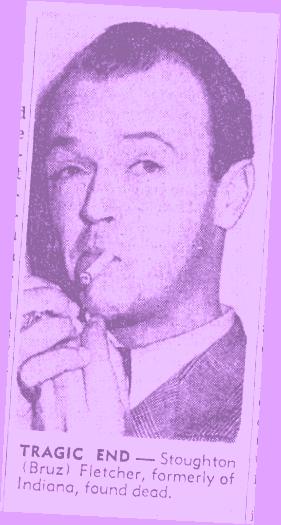
According to discographer David Diehl and author David Ehrenstein, due to frequent police crackdowns on gay performers and clubs, Bruz and many other performers could not find employment. He thus grew increasingly despondent and appaerntly committed suicide on Feb. 8, 1941, in Tarzana, California at the age of thirty-four. An obituary explained, “Until recently, young Fletcher was employed as an entertainer in Los Angeles night club where he performed for the movie colony with double entendre songs. According to family friends he was despondent because of impaired health and unemployment.” Variety also cited Bruz’s inability to find work as the probable cause. Earlier he had been threatening suicide because of that. Charles Cage writes that there is no documentation of exactly why Bruz killed himself though it is most often attributed to his frustrations not being able to find work. He had just spent the Christmas holidays in Saranac, New York, with his extended family and seemed fine then. His death came as a total shock to them. The strange circumstances of his death and the characters and places involved are typical of the high drama and mystery that shrouds his short complex life.
Bruz’s body was cremated in Canoga Park under the directions of his father who was living in Tarzana working as an elevator operator and there was no memorial service. He is not buried with the other Fletchers. After about a year and with some help from one of Bruz's aunts, Bruz's ashes were given to Casey. Bruz had been disillusioned and unhappy in Los Angeles and had no ties to Indiana so where to place Bruz was a bit of a quadry. Bruz loved monkeys. Before he kept them as pets and when Casey and Bruz romance first began, they would often visit the monkey house at the LA Zoo. Those were the days when Bruz was most happy. In a scene that must have been Felliniesque, Casey and a mob of friends brought Bruz's ashes to the San Diego Zoo and left him with the monkeys.
Bruz's Aunt Louisa once wrote:
I wish that there were some wonderful place Called the Land of Beginning Again, Where all our mistakes, and all our heartaches, And all of our poor selfish griefs Could be dropped like a shabby old coat at the door, And never be put on again.
But there is not such a place, or at least there was not for Bruz.
Bruz’s own words express much the same sentiments as penned by his aunt. Describing his character failed songwriter Peter Martin, Bruz wrote: “He wished he had a head master and was back in school. That someone could correct him and give him five black marks and allow him to start again. That was the horrible part about growing up. There wasn’t anyone to do that. There wasn’t anyone to apologize to or blame. It was always your own damn fault.”
Incidentally, Bruz's first novel did not live up to its jovial title. Instead, it begins with the cryptic dedication, “to Agnes, who makes life much less a hell than it was originally intended.”
In 1946, the wild Frances Faye made a daring choice to include Bruz’s “Drunk with Love” on her first album! She kept Bruz’s artistry alive by recording the song on 3 of her albums over her career and by performing in it concerts until she retired. By doing so in those closeted days, she outted herself to the gay folks in the audience who would know the record and its source. Yet she never mentioned its author and let the beauty of the song be unspoiled by its sad history. Marijane Meaker's new book, "Highsmith: A Romance of the 1950's," mentions that Faye’s rendition of the song was frequently played in lesbian bars of the era. Later Pearl Bailey recorded the song with alternate lyrics but silver ( from radiator paint!) haired chanteuse Joyce Byant gained noteriety recording a crazy interpretation of the orginal version which was publically banned from the radio. The label oddly also gave Bryant and Stuart writing credit! The 1950 sheet music of the song features Bryant on the cover but justly credits the song to Bruz. The change of format from 78 rpm to LPs in the early 50’s doomed Bruz’s recordings into a premature deep obscurity.
San Francisco saloon singer and inventor of the piano bar Wilbur Stump released an album that included the uncredited "Drunk with Love" on the occassion of his 75th birthday and to commemorate 63 years in show buisness in 1978. Closer to Fletcher's original version than to Faye's, the plaintiff lyrics must have struck a chord in the seven-times divorced, alcoholic nightclub performer. He can be heard singing the song in the 1985 film "My Mother Married Wilbur Stump." Peter Allen biographer Stephen MacLean wrote that urged by his assistant Bruce, “Peter had obsessively tried to find sheet music on “Drunk with Love,” but almost like Frances herself, could find no trace it ever existed except from her recording.” In 2004, singer Terese Genecco won “Entertainer of the Year” at a San Francisco Cabaret Competition singing Bruz’s “Drunk with Love.” She writes, “Since I was unable to locate the sheet music, I carefully transcribed the chords and lyrics to “Drunk With Love” and, during a showcase event held by the competition organizers, proceeded to regale the crowd of over two hundred with my best interpretation of Frances Faye, complete with the “ex-husband” introduction of my now amazingly talented and fabulous accompanist, Barry Lloyd. The room went wild. A gentleman in the audience contacted the producer the next day asking him to find out where I found a copy of the sheet music for “Drunk With Love!” It seems that Bruz, like his character Peter Martin, gave up trying to get publishers to buy his songs.
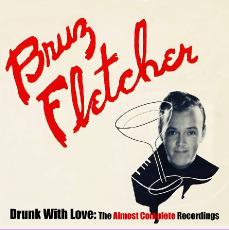
Other songs have lived on too. “She’s My Most Intimate Friend” was all but plagiarized for the great Bea Arthur number “Couldn’t Be Happier” in Ben Bagley’s Shoestring Revue. Carroll Davis' performance of "She's My Most Intimate Friend" can be seen in the 1985 documentary "Before Stonewall." Around 1950, Reta Ray, The Naughty Nightingale, recorded “Keep an Eye on Your Husband’s Business” which borrowed heavily from Bruz. As recently as 2006, Dr. Demento has on four occasions included “My Doctor” on his show. You can now hear part of "My Doctor" online at JD Doyle's Queer Music Heritage. Go to the June 2004 page: http://www.queermusicheritage.com/jun2004.html and hear the song. Drunk with Love is the title of the 2005 tribute show to Frances Faye and 2007 CD. Hear Bruz sing "Drunk with Love" at Radiolulu. Bruz's contirbution to gay life in the 1930's is featured in Stuart Timmons' new book Gay LA that received good online buzz and his 2006 article about Bruz and this site in The Gay and Lesbian Review . I have been informed about other exciting projects in the works.
Three time Academy Award Nominee Casey Roberts died of a stroke at the age of 48 in 1949. Bruz’s father later died at Saranac Lake, New York in October 1957 and in 1959 was inducted into The United States Harness Racing Hall of Fame. Bruz’s aunt Louisa died in 1956 and since 1997 a full-length portrait of her has hung in the Indianapolis Museum of Art. In 1984 Laurel Hall became the Indianapolis headquarters of the right-wing “think tank” the Hudson Institute. In February 2005 the estate went back on the market for only $250,000 more than it was originally built for! It is now the National Headquaters of a fraternity and has been lovingly restored. SOURCES: See Page 2 link below
Copyright Tyler Alpern 2004 - 2007 The website's content is copyrighted. No material from the site may be republished, copied, posted, rewritten, printed, photocopied, broadcast, publicly displayed, or distributed in any way without prior written permission except that you may view many of the site's pages with a web browser and you may print a single copy of those pages for your personal, noncommercial, home use. | ||
COMMENTS, QUESTIONS, THOUGHTS AND THEORIES
Georgia: Re the cryptic dedication of Bruz's first novel I am curious about Agnes. The Fletcher family as you have noticed were great believers in namesakes and there were at least a couple of Agnes in the larger family so I am guessing that Agnes could have been a cousin or aunt, perhaps someone with whom Bruz could share his true self. Like you I think that Bruz revealed much about personal details of his own life within the book. 9/7/04 {Agnes was Bruz's cousin, one year older. Her mother died in 1910 and Bruz's mother and Aunt Louisa fought to win her custody and that of her mother's body from the father. This could be the Agnes yet she was unknown to Louisa's much younger daughter - Tyler 6/23/05}
Terese: Well, I DID find a copy of the printed sheet music for "Drunk With Love!" It was given to me by Bob Johnson...Here's the scoop on this copy of the sheet music: Copyright 1950 by Preview Music Co., 6365 Selma Ave., Hollywood 28, Calif. International Copyright Secured; Printed in U.S.A.; All rights reserved including the right of public performance for profit; Arranged by Lou Halmy; BMI symbol on top left corner; by Bruz Fletcher. 9/8/04 (Notice that the date is 1950 and the lyrics are different but close. The first part of the song, which Frances did not ever record is omitted. The alternate radio lyrics have almost nothing to do with Bruz. Tyler)
MEANING IN BRUZ'S WORK Tyler: What do you think about the butlers? He seems to really distrust them. They are crooks, yet attractive to him, in both the book and Mrs. Lichtenfall. HMMMMMM. (The butler seemed to play a large roll in the article regarding the death of Bruz’s mother.) 9/6/04
Georgia 10/22: The short story is quite a discovery...His use of alter-egos (as you observe in the Miss Day lyrics) to express his emotions is pervasive. Wonder what else we might not be picking be on? Wonder what other writing he did that might be floating around.
No mention of Bruz by name in the latest article but certainly paints a picture of the times. The full title is actually "L.A. and 'Lily Law': A Talk with David Hanna". "Lily law" is explained along w/ other slang of the time on p179: "...where they took all the arrested gays was called the 'fruit tank,' and the law was called 'lily law.' So in L.A. you had to look out for 'lily law'!" Makes me recall the alternate title to "It", "Peter/ Lillie /Daisy. Another connection?
Tyler: You must be right, as demonstrated by his songs, the double meaning of words was not lost on Bruz. I think he chose his names and words wisely. Also - I did find a short blurb in Variety about NYC authorities twice preventing the premiere of a show at a club in 1936 just because there was drag at that location the previous year despite the club having since changed owners, management and name. Tough.
Stuart 5/05: ...Oh, and "Lily Law" was a joking code/drag name for policemen themselves. The way the site is written, it looks like you mean they talked about "lily laws" against gay stuff -- not the case as far as I know. (They also would refer to a cop a "Miss Alice Bluegown," after an old Broadway show tune. Using such a signal was a way for queens to know to tone it down, butch it up, etc.)
Georgia: I read 100 or so pages of the second book last night. The plot is so contrived it's terrible. However some of the details are amusing: *Jennifer, the main character, and her mother share the last name Ambar. Are you familiar w/ Booth Tarkington’s novel "The Magnificent Ambersons? “ Published in 1918...was awarded a Pulitzer Prize in 1919...traces the growth of the US through the decline of the once-powerful, socially prominent Amberson family. Popular wisdom holds that Tarkington based the Ambersons on the Fletcher family. Could Bruz be playing w/ Ambar & Amberson? *By p 14 the young heiress is on a cruise w/ her sympathetic grandmother. A young first mate is sketched who returns from shore leave drunk &singing "ribald limericks" w/in earshot of the grandmother, who, whenthe mate sobers up she "raised his salary and gave him a small notebook in which he was to write the songs he had sung and return it to her." *On p16 Jennifer, age 14, confesses to grandmother "I have very odd ideas about love." Some pages later at 16 she elaborates on the odd ideas. *By p 35 she meets a dashing pilot (she also has her license) whose name is---this is SO over the top--Gayland Boye! Can you believe it? *P 98 Grandmother attends funeral in Chicago and then remarks on the subject of life "...one is always best out of it." Again like the lyrics of "Miss Day," the foreshadowing of Bruz's suicidal future.
...I did finish reading Bruz's 2nd novel. It did not get any better. There continue to be hints from his life in the book, most of which go over my head (the main character, Jennifer Ambar, uses a pseudonym "Daisy Flee"--not sure what the significance is but probably had some to Bruz.)
Tyler: Hmmmm, that is the second time he used the name Daisy. I wonder if Miss Day is another variation of that. There are several socialites who go into the arts or performing that he writes about too. Could Daisy turn out to be a nickname for his wild sister? We may never know. Thanks for the copy of the second novel. I think it is an improvement over his first effort. The rough sex verging on kink that 16 year old Jennifer Ambar yearns for and describes to her grandmother certainly seems out of character for an innocent society girl! What is Bruz telling us here? That he was a biter, a masochist, a bottom? "I'd like some man, some strong man, some big, good-looking, rugged man to love me. To see me and just, just- possess me... I'd like to feel the thrill of that. I'd like him to hold me tight, oh, awfully tight, I'd like him to hurt me and then - I'd like to bite into his flesh, his neck..." I also think Bruz is telling us more about his preferences in his song "The Prairie" when he interjects: "Any turkey that is superior loves it stuck in its posterior but appearance not withstanding I am no bird." Stuart adds that it was more common then for men to draw the line at anal sex and that Bruz wisely clipped along so fast in his songs that some of the most outrageous meanings went flying over the heads of his audience.
12/14/04 Georgia: Here's something else exciting-- a series of articles that a librarian friend of mine at the local university found. Definitely new light on the second book. I'll forward the series. (Details of Lousia's running away and failed marriage - see "Family Page") Tyler: Wow, so much of that ridiculous plot was true: the failed society wedding to foreign nobility, running away without money, using an alias! The "Flee" in Daisy Flee certainly applies to Louisa. It just seemed like his sister had to figure in the book. Now we can really see that. Georgia: Hmm--The photo of his sister along with the story of Louisa running away & working as a farm hand makes me think that the song "Peter / Lillie / Daisy" wasn't just about Bruz's gender dysphoria.
Georgia 01/05: In Nov. 1939 there is a story in the LA Times about Fletcher's two monkeys ... On the subject of monkeys, in Bruz’s ‘Hello Darling,’ there was some reference to "primate urge" and sleeping w/ monkeys--he just drew inspiration from his every aspect of his life. Tyler: You are right! I forgot all about that part of the song. We are getting so used to Bruz putting bits of himself all over his writing. As soon as we find a real-life fact, there is a correlation in the writing we already know. I am reminded of the line Roger Edens wrote for Judy Garland “the history of my life is in my songs...” I just read "Out of the Past" to learn more about gay history and attitudes and laws of Bruz's era. With that in mind, I have been thinking about the text you remembered in Hello Darling: "The new psychiatrist that I am going to in the Bleeker Building says that I’ve got a primate urge, yens to sleep with monkeys, marmosets - anything with a big tail. I’ll have to marry Gargantua before I get through. Don’t you understand - it’s my only escape! Waiter, it’s coming on me again. Send out quickly and get me an ape!" I think Bruz is using his fondness of monkeys as a metaphor to mock an era that considered homosexuality a perversion and a sickness to be cured. He would have to use metaphor and comedy to express such ideas, no one was speaking out about things like that publicly at the time. I think it may be his most daring lyric. The same device was later used in Cabaret in the song "If You Could See Her Through My Eyes" where an ape is substituted for a Jewish girlfriend.
Georgia 5/05: I was just rolling the Lady Bathurst affair over in my mind wondering of there could be any borrowing of material from Louisa & Bruz's row over clothing and a woman who was (Lady Bathurst) who was playing them? Need to have more details (was Louisa attracted to women for one thing?) on that whole business to really draw any conclusion. Tyler: I don't know. Louisa's lady "companion" Ruth in that whole affair made me wonder, let alone Lady Bathurst. And after all Louisa did run off and live under a man's identity. It certainly runs in her family with her brother and Aunt Hilda. Did you see that butch photo of the young Hilda?
GAY PERFORMERS Mark Trevorrow, famous in Australia and UK as entertainer "Bob Downe," writes: In fact, I did my Mark concert here in Sydney only last night... and my dear parents were there to see it, and they received an ovation of their own. People seem very moved by the fact that I am completely, wildly OUT (and have been for twenty years) and that they love and support me in it...in fact, as I write this, I realize how important and unusual that fact is - and it makes me sad and furious that so many gay people still have so far to go reaching this kind of acceptance. Hopefully I'm making a difference! I feel I am. I just wish more well known people here would have the courage to come out - particularly rock/pop and sports stars. (they know who they are!) I have such huge admiration for Ellen, Rosie, k.d., and other American stars (also Alan Cummings and Ian McKellen) who have come out - not even the gay community appreciates how fraught and terrifying it is for these pioneers, who have literally risked their careers for the sake of honesty and change. Mind you - we also must remember how much times have changed since dear Bruz Fletcher tragically killed himself, and under those unbelievably fantastic circumstances. They sure as hell can't stop us working now - as much as they'd LIKE to!!! *ggrrrr* don't get me started...
Georgia: I'm forwarding a couple of messages from friends of mine who have looked at the Bruz website. The first is from James Benn, a talented artist & performer originally from Indianapolis, currently living in NYC and working as the "choir director" for the Reverend Billy & the Church of Stop Shopping. (Check the website http://www.revbilly.com/ if you don't know Rev Billy.) Hey Georgia, Thank you so much for the Bruz Fletcher CD. He is hilarious, witty, bawdy and loads of fun. That's the kind of high-dollar cabaret sissy I aspire to be. But more on the lines of a Bobby Short or Mabel Mercer making a grand entrance through a trap door at Carnegie Hall. Peace & love, JB
CASEY ROBERTS & JULIA BALLARD As I begun this project, I doubted I would ever uncover Bruz's partner. Slowly information trickled in. We had already encountered his name but not noticed its significance when an email from the daughter of one of the silent screen stars Bruz wrote material for wrote us and mentioned Casey. Here are some exchanges between Georgia and me as the story came to light:
Tyler 12/15/04: There is only one reference to Bruz being married. A 1974 volume titled "Indiana Authors and Their Books" devotes one paragraph to Bruz. It lists an incorrect year of birth and mentions that he was married to Julia Ballard. Very often Bruz (Stoughton J. IV) is confused with the other six Stoughtons and given the wrong number and initial. Even in his mother's, his sister's and in his own obituary the wrong Stoughton is named for him! The first Stoughton was married to Julia Bullard and Bruz's aunt was named after her, Bruz's dad's sister is also named Julia Bullard Fletcher. I think some sloppy research resulted in attributing this marriage to Bruz. After much checking including marriage records no other source mentions his union with Julia Ballard, nor does she appear in any newspaper articles from the 20s about the Fletcher Family. {6/05: Family confirms: ......As for your questions, the only one she could answer definitively was the one about marriage -- Bruz was not married, ever. So your theory about sloppy research proves out.}
Georgia: I am inclined to agree at this point about the sloppy research on the Bullard v Ballard. However I still wonder about the Ballard name in the Jones Magazine story. PS--I just noticed in the Esther Ralston excerpt that she mentions Casey Roberts was in the entourage w/ Bruz & others when she took her show to Chicago. I also see a Casey Roberts w/ a credit for set design on a 1943 film "Background to Danger." (Casey was first mentioned to us in an email from someone who knew them and then we started to notice him in our exisiting research. For instance he drewthe portrait we had of Bruz used as a bookplate for Bruz's first novel - Tyler.)
Tyler: That also makes me think his song 'The Prairie.' I did a lot of looking to understand the line "my buddies Casey and Lee." There are no obvious rodeo, cowboy, literature references to Casey BEFORE 1940. Casey and Lee are not connected. There is a strong cowboy connection with Lee jeans, especially in the 30's. This may or not be what he means. I looked very hard for Casey in that context: hats, saddles, guns, characters, stars, legends but nothing seemed to fit. I had not thought of the bookplate when I read letter we received about Bruz and Casey working on that other act. "Casey and Lee" could be personal friends. It will be interesting to see she has to say about Bruz and Casey when she expands on her first email.
Georgia: Do you suppose that Bruz loved that man (Casey)? I got the sense from her quick note that Bruz & Casey visited her family's home as a couple--maybe I just want to read it into the picture, but I think it is a possibility.
Tyler: I do think it is a strong possibility. It is the letter that gives me that idea as well, supported by Bruz's high profile use of the drawing. It is interesting that they seem to have collaborated on more than one act and that a costume and curtain designer was needed to tour with a Vaudeville act. More likely he went along as a companion. Casey went on to a big career in set design with 3 Academy Award nominations. Thru Casey may be how Bruz knew Howard Greer and Sowden. Greer also worked with Leatrice Joy in the 20s so she may be their connection.
-5/05 Later we found many articles and documents that linked Bruz and Casey and heard from the family about them as a couple. A letter from Greer, who frequented the Bali regularly, hints at an affair between James Broughton and Casey: "Have you ever seen thermometers yanked quickly from ice-boxes to desert heats? Well, my pet, you old human thermometer I've for nearly the past week, been clouded with the frost that coats those well-hung quarters of beef. Clouded and disheartened! No mail - no telegrams - not even a mention in Winchell! And then - this morning - a letter. The glass cleaned - the mercury shot up the tube & whirled like a dervish in the little bulb at the top - until - oh dear God - until I reached the end of the letter - where there was a mention of one Casey & threats of what I'd be hearing when the lovely Sowden returned. And me - the dramatic - the girl who always believes what she shouldn't. Back to the ice-box - the thaw was over! Now I'll be irritable for days, I suppose, and all my "help" will dodge behind bolts of gold cloth when they see me approaching. Casey! Casey indeed! Anybody indeed, indeed! I could run amuck with my trusty scissors & leave a trail of jugulars in my wake!!
03/06: Georgia: ...Alice Williamson's article certainly gives depth to life at Bruz & Casey's place. Another detail I found interesting was in the article about the library Casey was assembling for the set of Little Lord Fauntleroy - the two portraits by Sir Peter Lily. ( recall the lyrics "poor Peter Lilly Daisy...") Is Peter Lily an artist you know ? I also thought about how an antiques business would mesh w/ a career as a set designer. I laugh when I recall some of our early speculations about the possibility of a relationship between Bruz & Casey.
Tyler: I too am intrigued by the song "Cocaine' and whatever implications it has. I did not even notice or think about Peter Lily. I don't know him. That would merit looking into. I am really glad that we took it slow with Casey. It is so clear to us now how important he was, and we were right to suspect it but we didn't want to make up a story that wasn't there. After all, when Leatrice wrote us, she gave us a slightly different last name and we had some important Casey Roberts pieces and they had slipped under the radar. It shows how invisible they actually could have been in those days. The other find, that sad piece about Casey's death, finances and being out of work really moved me. The LA times obit mentioned none of that.
REACTIONS Stephen MacLean: That site is just wonderful... and shall write more later, but off the top of my pointed head, a) Aunt Louise Fletcher's poem just heart breaking and I USUALLY hate poems b) Have you read the wondrous Dawn Powel...perhaps the first one to read would be THE LOCUSTS HAVE NO KING, my fave I think THE GOLDEN SPUR, and the cover of THIS HAPPY ISLAND showing a 30's Manhattan nitery with a fag singing and the novel itself is dedicated if I'm right to Dwight Fiske - Dawn stands alone - but it's the same world as your site that Dawn Powell paints in her 13 novels and the same kind of unsparing wit from a city of a country (Manhattan, USA) that no longer exists...Bruz Fletcher's the thing. Bravo Tyler chap! 9/6/04 Again BF site so good can't wait to look at it again. 9/7/04
Allen Bardin (9/25/04): Bruz is such a find! I've gone nuts for him --- and so has Freeman! (I guess you've heard from him by now.) "Spring in Manhattan" is just one of my new favorite things, I'd really love to hear more of his ballad-type things. But, GET IT UP KITTY, ranks right up there with Porter & Coward!
Freeman Gunter (10/01 /04): have just returned from a visit to Allen "Tops in Chops" Bardin in Columbia and was totally, totally charmed and astonished by Bruz Fletcher's recordings. Known to me since the age of twelve only by the liner notes of No Reservations with Frances Faye, I was thrilled to discover his unique, elegant singing and material. What a wonderful song stylist! And I can hear clearly that he was a major inspiration for our fabulous Fayzie!
Tyler: I just noticed on the album jacket for No Reservations 'Drunk with Love' is attributed to "Queenie Smith." I wonder what that is all about??????? Queenie was a big nightclub and stage star at the time. Bruz may have originally written 'Drunk with Love' for her.
Freeman: On my original No Reservations LP, Bruz is credited in the liner notes, but, sure enuff, Queenie Smith is on the actual record label. I will type the liner notes for No Reservations: "All the high voltage showmanship that has made Frances Faye one of the world's most popular after-dark entertainers is revealed in this carefully recorded collection of the frantic Fayzie's most requested numbers. The daring and dramatic interpretation of Bruz Fletcher's 'Drunk With Love' is remarkably uninhibited, and equally arresting are her encounters with the best of Gershwin, Coward, McHugh, and other top-drawer modern popular composers..." I read this when I discovered this LP at age twelve and I have wondered about this name ever since. I have copied Bruz for Drew. He is going to freak out as this is just the kind of stuff that fascinates him.
(Later research has revealed 3 articles about Queenie and Bruz attending at the same parties and she appeared in Bruz's 1933 play and in a 1934 benefit with him. 5/05) ( 7/30/07: New research reveals that in 1932 while living in Newport's Washingtion Street artists' colony with Casey, Bruz was writing songs for a new revue for Smith and others and this may be where the song was introduced and how she mysteriously became associated with it as the writer. Faye's first recording of the song is uncredited as is Wilbur Stump's although the other songs on both albums are credited.)
Freeman (10/04): Well, Drew went absolutely nuts as I have never seen him do! He listened with rapt attention to the entire disc, his face contorted into a mask of astonishment and hilarity, but afraid to make a sound for fear of missing a single world or sparkling couplet. We both agreed that this is a level of genius equaled by very, very few. I knew he would react just this way. I am sure you will be hearing from him although I have already made him a copy of the disk and playlist. This man must be resurrected. Forget Christ...
Tyler: You and Drew are absolutely right about Bruz's gift. I have been listening to a lot of Spivy, Dwight Fiske, Nan Blakstone and other better remembered singers of that genre and era and Bruz really shines as a talent in a class above them all. I am sure his early death and switch to LP’s is why the others are better known. I am doing all I can to get the word out...
Freeman: Not only is Fletcher a genius performer, but the material itself is absolutely unique and prodigious. Many performers have switched from 78s to LPs. Why not Bruz?
Tyler: Well, I think people like Fiske, Blakstone and Bourbon were still alive when LPs came out and had more recent contracts. Bruz put out some of his own records and he was a long dead gay performer without and agent or heir by the time LPs came out. Who would have invested money in that? Spivy was alive and far more current and a great self-promoter. Where is her LP?
Stuart 5/05:...One thing that you might want to add to your background on the career is a bit about Hollywood culture and the unusual place for discreet gays allowed within it. Bill Mann's book Wisecracker has some good material, as do other references you have. Patrick McGilligan's bio of George Cukor is also very good. If you don't have any, I might be able to find some of the Variety articles that talk about "the panze business." ... Anyhow, I hope this is of some help. I really look forward to seeing the progress of this great project.
9/06: My name is Mark Miller. I'm a musician in Los Angeles. Recently a disc jockey from Sacramento who has played some of my recordings sent me two CD's of music from his extensive collection of '78's. One was "Whispering" Jack Smith, the other Bruz Fletcher, who was completely unknown to me. I listened to the Bruz Fletcher with delight for a couple of days, then made an inquiry on the newsgroup "Songbirds", and was directed to your amazing website. I can't tell you how much I've enjoyed it. It is exhaustively researched, and something you should be very proud of! It has been a treat for me to learn about the remarkable, sad, joyous and tumultuous life of the very clever wit behind those great old recordings. Thanks again! Sincerely, Mark
11/06: from my book-in-progress
THE ARROW THAT IS HOLLYWOOD PIERCES THE SOUL THAT IS ME :
BRUZ FLETCHER ENTERTAINS AT CLUB BALI
Louise Brooks poses on coral couch while her escort Travis Banton banters with a waiter in a red sarong
but all hush when Bruz comes to the piano
this is a pansy club & Bruz does not disappoint his lyrics point & prod but with a wink or lick
he knows who is a friend & who is not
Alex Gildzen Santa Fe
Contact Tyler Alpern at Tyler_Alpern@yahoo.com to contribute or comment. | ||
About your host Tyler: | ||||||||||||||
Copyright Tyler Alpern 2004 - 2007 The website's content is copyrighted. No material from the site may be republished, copied, posted, rewritten, printed, photocopied, broadcast, publicly displayed, or distributed in any way without prior written permission except that you may view many of the site's pages with a web browser and you may print a single copy of those pages for your personal, noncommercial, home use. Sources used such as "LA and the Lily Law" by Lester Strong & David Hanna, Journal of Gay, Lesbian and Bisexual Identity V4 #2, 1999 are listed on page 2. | ||||||||||||||