| ||||
 | ||||
 | | | | |

| ||
| | |

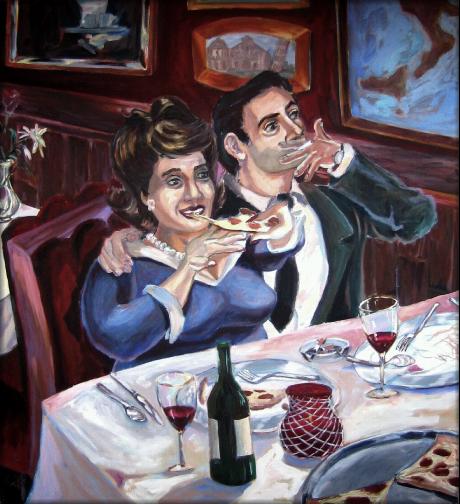 | ||||
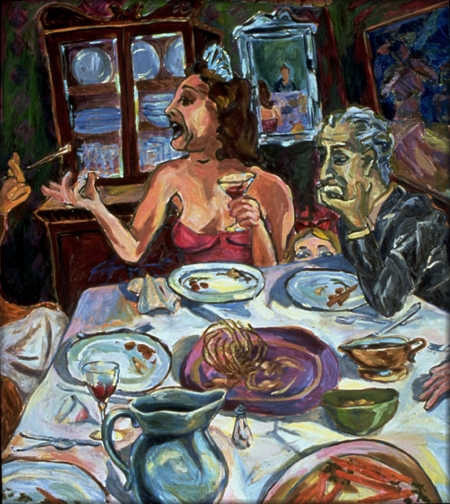
They Call It, "Bella Notte." I think this painting is all about sex without being graphic. The evening is not yet over. Oil on canvas, 48' x 43" | ||||
| | | | |
Click on painting to enlarge. | ||
| | |
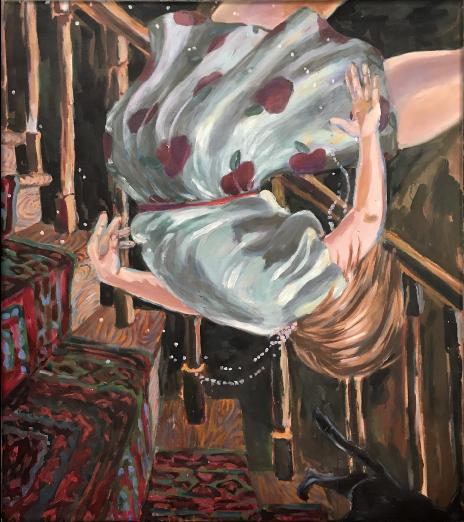 | ||||
Isaac. This painting was inspired by the motion of breaking beads and by a black cat I know named Isaac who in this painting is fleeing down the stairs. The woman is having serious trouble with gravity, so the apple print on the skirt honors Sir Isaac Newton, who in turn was inspired by the falling motion of another apple. Oil on canvas, 40" x 30" | ||||
| | | | |
Click on painting to enlarge. | ||
| | |
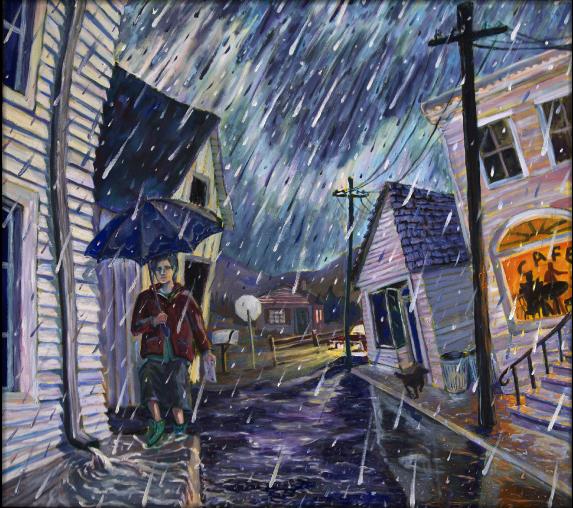
Rain
A woman carries a letter and umbrella through the pouring rain. The huge raindrops in the foreground.place the viewer right in the picture, in the rain, not merely looking at it from afar or thru a window. 42” x 48” Giclee available too. | ||||
 | ||||
| | | | |
 | ||
| | |
Click on painting to enlarge. | ||
| | |
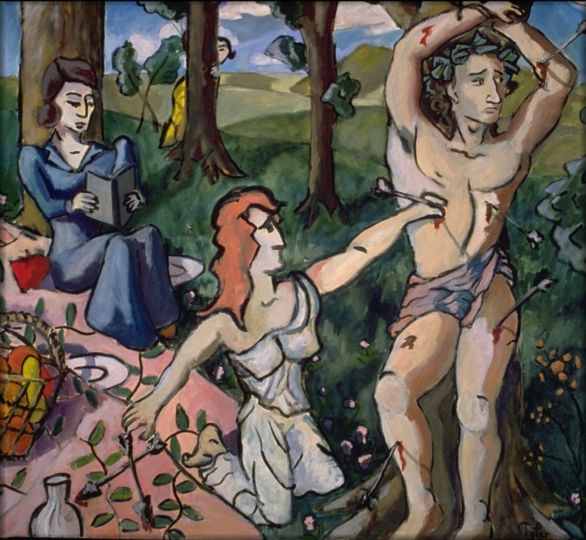
Picnic with St. Sebastian.
For centuries St. Sebastian has been a homoerotic icon in the church. Somehow, Sebastian ended up looking a lot like me. I painted this as a parody of the outdated symbology of the senusal martyr yet turned out to be a revealing self portrait in ways I could not have even imagined at time.
Oil on Canvas 48" x 44" | ||
| | |
 | ||||
| | | | |
Click on painting to enlarge. | ||
| | |
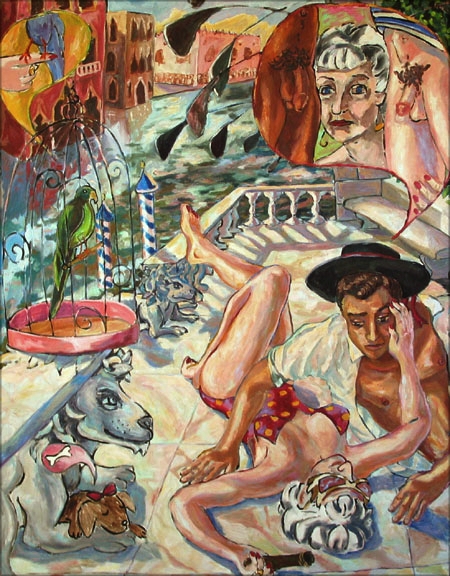 | ||||||
Peggy’s Fury is based on a quote from the outrageous art patron Peggy Guggenheim's autobiography. Notoriously promiscuous, she wrote, "I am so furious at all the men who, while they were sleeping with me, were only thinking of sleeping with the other men I had been with." I thought of all the injustices in this world, what a silly thing to waste one's fury on! Peggy is on her back, a position she well knows. It is the same pose found in a Barbasol ad opposite Life Magazine's famous article about Jackson Pollock that she is conpiculously absent from even though her sponsorship freed him to paint. By duplicating the pose, I put her on the page in Life she should have been on. The prone Peggy caresses the face of her gondolier while he is thinking of another guy. Even her bird is thinking of another bird (her husband Max Ernst always painted himself as a bird and yes, left Peggy for another woman.) One of her many lap dogs (that she is buried along side) is dreaming of a bone as food is more important to a dog than sex. Peggy is holding the odd shaped pipe like removable erection from Marino Marini’s Sculpture Angel of the City that graces her Grand Canal terrace. The nuns used to float by her house every Wednesday and Peggy would unscrew the erect phallus so as not to offend them. However, I wonder if nuns would be more offended by a man with a vagina than a man with an erection? Anyway, as much as it is a portriat of Peggy Guggenheim, I really think of it as a painting about me and my summer working in Venice at her museum and the adventures I had there. 60" x 50" | ||||||
Click on painting to enlarge. | ||||||
| | | | | | |
Portrait of Peggy Guggenheim | ||
| | |
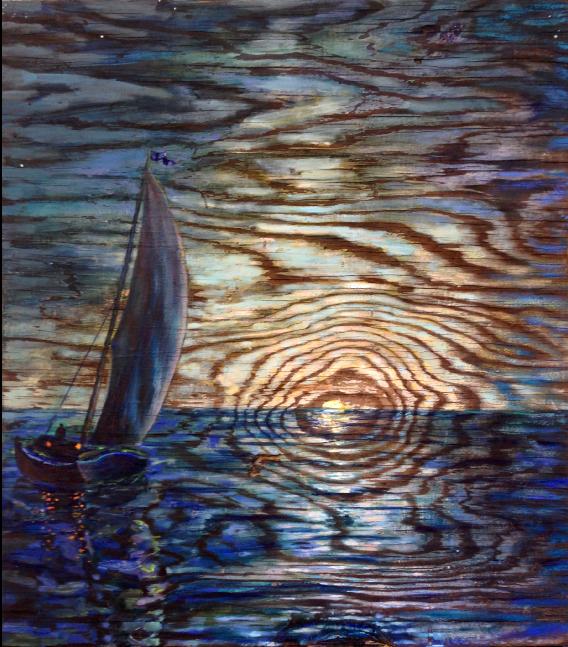 | ||||
Moonlit Passage. Communing with nature is one of the best ways I find my own sense of joy and peace.. And I never like to be too far away from water - if even a trickling stream. Watching the energy and majesty of a waterfall cascading down or seeing the light glisten and dance on the surface of the water are among the most mesmerizing of nature's wonders. I feel like this image was lurking in the wood grain all the time ust waiting to be brought out. The wood grain itself is an archivist, documenting the history of water, or rather precipitation, in the thickness its rings. The moon sits on the horizon and sparkles across the water. The glowing sky reflected here creates a guiding tunnel, a portal into the unknown. It is that magic moment of transition between light and darkness. 18" x 21" | ||||
| | | | |
 | ||
| | |
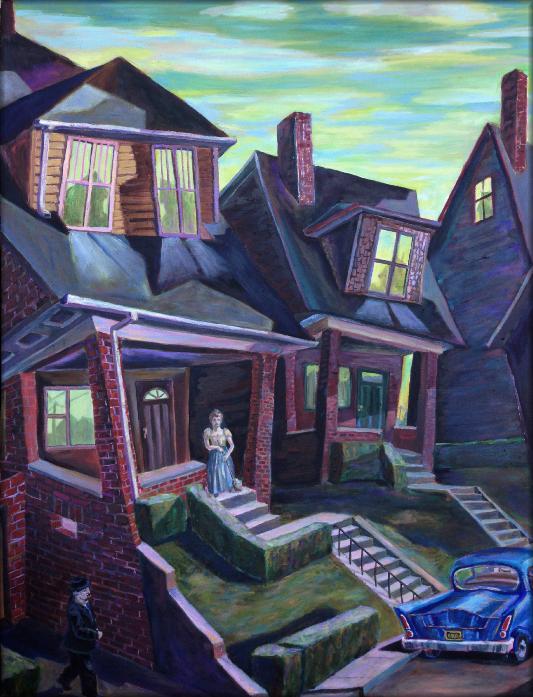
From the Steppes of Russia to the Steps of Pittsburgh. A Russian influenced painting of my Russian born Jewish grandparents in their adopted home of Pittsburgh. This is their house at 6352 Crombie Street. Modelled after 3 Russian paintings, it is an exploration of my genetic and artistic roots. | ||
| | |
 | ||
| | |
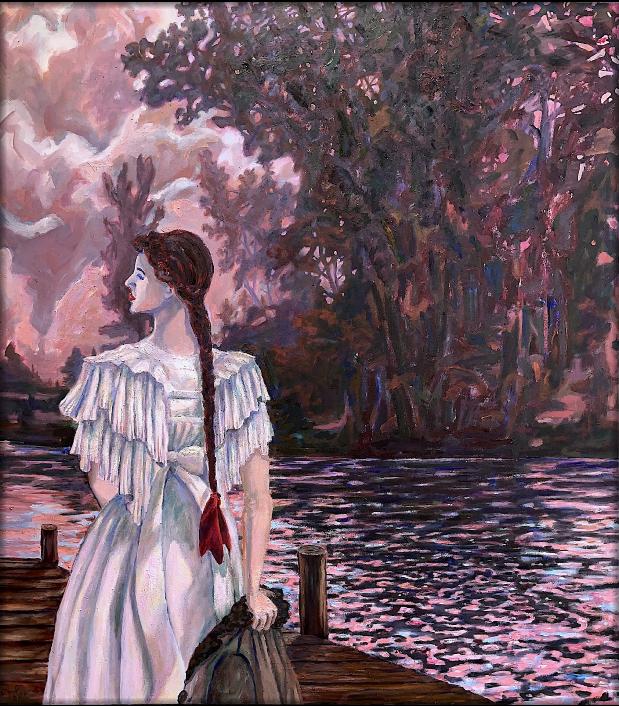
Louisa Fletcher in the Land of Beginning Again Oil on Canvas 43" x 48". Bruz Fletcher's celebrated aunt, the poet Louisa Fletcher, is leaving behind a"shabby old coat" as she enters the misty, pink shrouded landscape on a journey to make a new start for herself. That act being a metaphor of moving on from her grief, something she expressed in her most famous poem written during her divorce from Booth Tarkington:
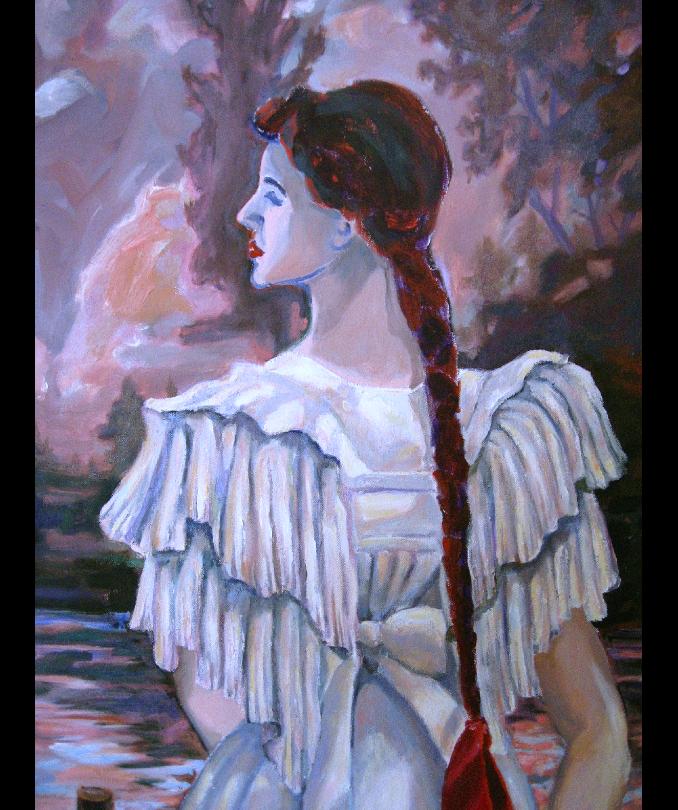
This painting was reimagined in 2025, when I removed the foreground figure of Fletcher's doomed, wild niece also named Louisa Fletcher, who was also caught in the act of fleeing her old life as she cut her hair to disguise herself as a man. Elements of her silhouette still remain as a shadow in the trees and water. See the original painting to then try to sense her dark ghost image here. | ||
| | |
 | ||
| | |
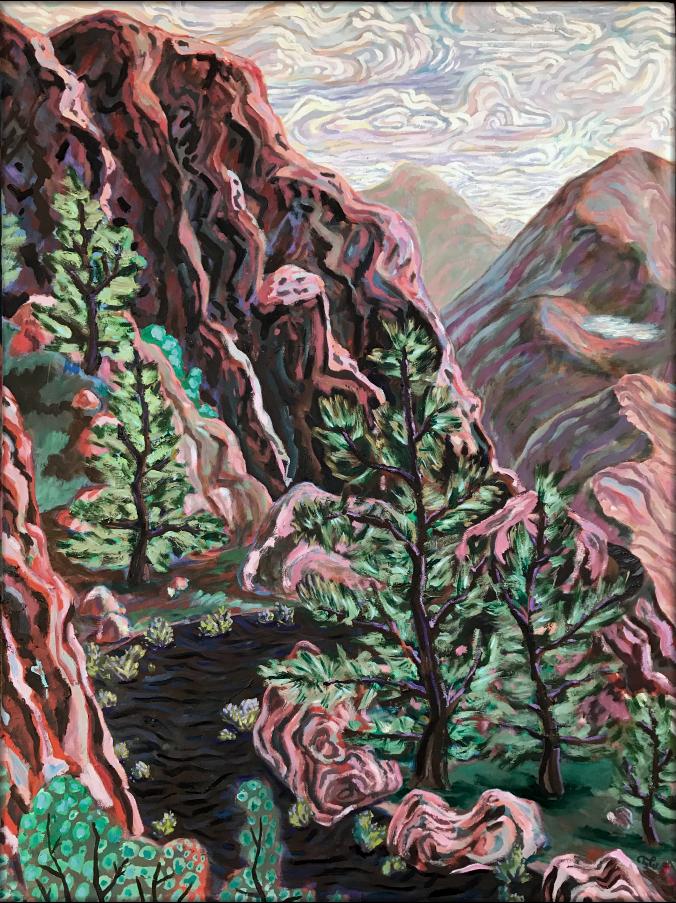
The Rocky Trail A landscape created out of elements of Colorado's Front Range where I live now and the Western Slope where I grew up. I approach landscape as a caricature, as a depiction of a place's personality. I collage elements of the immersive experience and the passage through the space to capture what the camera can't: the feelings of awe, multiple vistas (both near and far), inspiration, majesty and memories of what you see and encounter throughout the whole day along the trail, not in just a single Kodak moment. In that way, the artwork can better recreate the sensual impact of being outside and engaging with the environment. This is actually one of my personal favorites of my work. | ||
| | |
 | ||
| | |
 | ||
| | |
 | ||
| | |